Choosing the right cloud provider can make or break an early-stage startup. Infrastructure decisions impact your burn rate, scalability, security, and product velocity.
In this guide, we compare Amazon Web Services and Google Cloud Platform to help founders, CTOs, and technical teams decide the best cloud for startups in 2026.
We’ll break down pricing, startup credits, scalability, ease of use, DevOps tooling, AI capabilities, and long-term growth potential.
Why Cloud Choice Matters for Early-Stage Startups
For early-stage companies, the cloud isn’t just infrastructure it’s:
- Your hosting environment
- Your DevOps backbone
- Your data platform
- Your AI/ML engine
- Your disaster recovery solution
Startups typically look for:
- Low upfront costs
- Generous startup credits
- Fast product development
- Easy scalability
- Reliable security
So, AWS vs GCP for startups which one wins?
AWS vs GCP Startup Credits
AWS Activate for Startups
AWS offers AWS Activate, which provides:
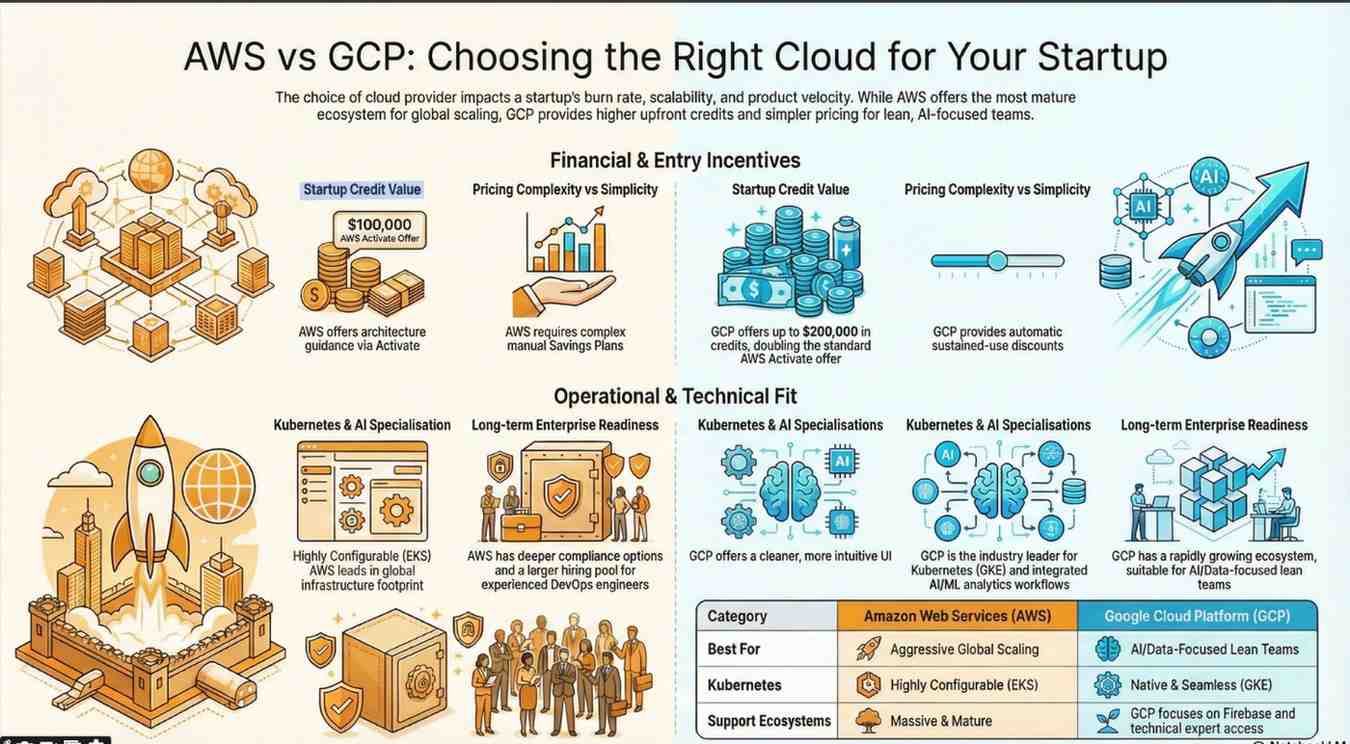
- Up to $100,000 in AWS credits (sometimes more via VC partnerships)
- Technical support
- Architecture guidance
- Training resources
For VC-backed startups, AWS Activate is often very attractive.
Google for Startups Cloud Program
GCP offers:
- Up to $200,000 in Google Cloud credits
- Dedicated startup support
- Access to technical experts
- Firebase growth support
Keyword insight: Many founders search for “AWS vs GCP startup credits comparison” and GCP often offers larger credits upfront.
Winner for credits: GCP (usually higher credit value)
AWS vs GCP Pricing for Startups
When evaluating AWS pricing for startups vs GCP pricing for startups, here’s what matters:
AWS Pricing Model
- Pay-as-you-go
- Reserved instances for discounts
- Savings Plans
- Complex pricing structure
AWS has more pricing options but it can be harder to estimate costs.
GCP Pricing Model
- Sustained use discounts (automatic)
- Committed use discounts
- Simpler pricing calculator
- Per-second billing
GCP’s automatic discounts are attractive for startups without a dedicated FinOps team.
If you’re searching for “cost-effective cloud for startups”, GCP is often easier to manage early on.
Winner for simplicity: GCP
Winner for flexibility at scale: AWS
Ease of Use & Learning Curve
Startups move fast. Developer productivity matters.
AWS
- Massive ecosystem
- 200+ services
- Powerful but complex
- Steeper learning curve
GCP
- Cleaner UI
- Fewer services (but focused)
- Developer-friendly design
- Strong integration with open-source tools
For small teams without a dedicated cloud architect, GCP can feel more intuitive.
Best cloud for small startup teams: GCP
Best for experienced DevOps teams: AWS
Scalability & Global Infrastructure
Scalability is where AWS traditionally shines.
AWS Strengths
- Largest global infrastructure footprint
- Mature ecosystem
- Highly customizable architecture
- Enterprise-ready services
AWS is often considered the safest long-term bet for hypergrowth startups.
GCP Strengths
- Strong global network
- High-performance infrastructure
- Excellent container support
If your startup plans rapid global expansion, AWS has a slight edge in region availability.
Winner for global scale: AWS
Kubernetes & DevOps: AWS vs GCP
Many early-stage SaaS startups use containers.
AWS Kubernetes
- Amazon EKS
- Highly configurable
- More setup required
GCP Kubernetes
- Google Kubernetes Engine (GKE)
- Built by Kubernetes creators
- Easier cluster management
If your startup is Kubernetes-heavy, GCP often feels more natural.
Best cloud for Kubernetes startups: GCP
AI & Machine Learning for Startups
If you’re building an AI startup, this matters a lot.
AWS AI Services
- SageMaker
- Broad AI tooling
- Enterprise AI features
GCP AI Services
- Vertex AI
- Strong data + AI integration
- Excellent analytics stack
GCP has strong credibility in data and machine learning due to Google’s AI leadership.
Best cloud for AI startups: Slight edge to GCP
Security & Compliance
Security is critical even for early-stage companies.
Both AWS and GCP provide:
- SOC 2
- ISO certifications
- GDPR compliance
- IAM controls
AWS has more enterprise-grade compliance options overall, which may matter later when raising Series B+ funding.
Winner for enterprise compliance depth: AWS
Ecosystem & Community Support
AWS
- Largest cloud provider
- Huge documentation library
- Massive third-party ecosystem
- More hiring pool
GCP
- Growing ecosystem
- Strong startup community
- Popular among AI/data startups
If you’re thinking long-term hiring strategy, AWS skills are currently more common globally.
Winner for ecosystem maturity: AWS
Real-World Startup Use Cases
Many high-growth startups choose AWS for scalability and ecosystem stability.
Meanwhile, data-driven and AI-first startups often lean toward GCP due to analytics advantages.
But here’s the truth:
Both platforms can support a unicorn-scale startup.
The better question is:
What does your product need in the next 12–24 months?
Final Verdict: Which Is the Best Cloud for Early-Stage Startups?
Here’s a simplified decision framework:
Choose AWS if:
- You plan aggressive global scaling
- You want the largest ecosystem
- You expect enterprise clients early
- You have DevOps expertise
Choose GCP if:
- You want larger startup credits
- Your team is small
- You’re AI/data-focused
- You prefer simpler pricing
Quick Comparison Table
| Category | AWS | GCP |
|---|---|---|
| Startup Credits | Good | Excellent |
| Pricing Simplicity | Moderate | Simple |
| Global Reach | Excellent | Very Good |
| AI/ML | Strong | Very Strong |
| Kubernetes | Good | Excellent |
| Ecosystem | Massive | Growing |
Bottom Line
When comparing AWS vs GCP for startups, there is no universal winner.
- Best overall long-term scalability: AWS
- Best for lean, AI-focused early-stage startups: GCP
- Best cloud for startups with big credits needs: GCP
- Safest enterprise-ready bet: AWS
For most early-stage founders, the real advantage comes from:
- Using startup credits wisely
- Building cost-efficient architecture
- Avoiding over-engineering early