
Cloud computing is no longer the future it’s the present. As businesses rapidly migrate to the cloud, Amazon Web Services (AWS) has emerged as one of the leading platforms powering this transformation. With AWS certifications gaining global recognition, professionals across industries are leveraging them to unlock high-paying and future-proof careers.
But a common question remains: What job roles can you actually get after AWS certification?
In this in-depth guide, we’ll explore the top job roles available after earning an AWS certification, what each role involves, the skills required, and how you can position yourself to land these opportunities.
Why AWS Certification Matters for Your Career
Before diving into job roles, it’s important to understand why AWS certification holds value.
AWS certifications validate your ability to:
- Design and deploy cloud-based solutions
- Manage infrastructure at scale
- Implement security and compliance
- Optimize performance and cost
For employers, it’s proof that you have practical cloud knowledge, not just theoretical understanding. For you, it opens doors to roles that are in high demand across industries.
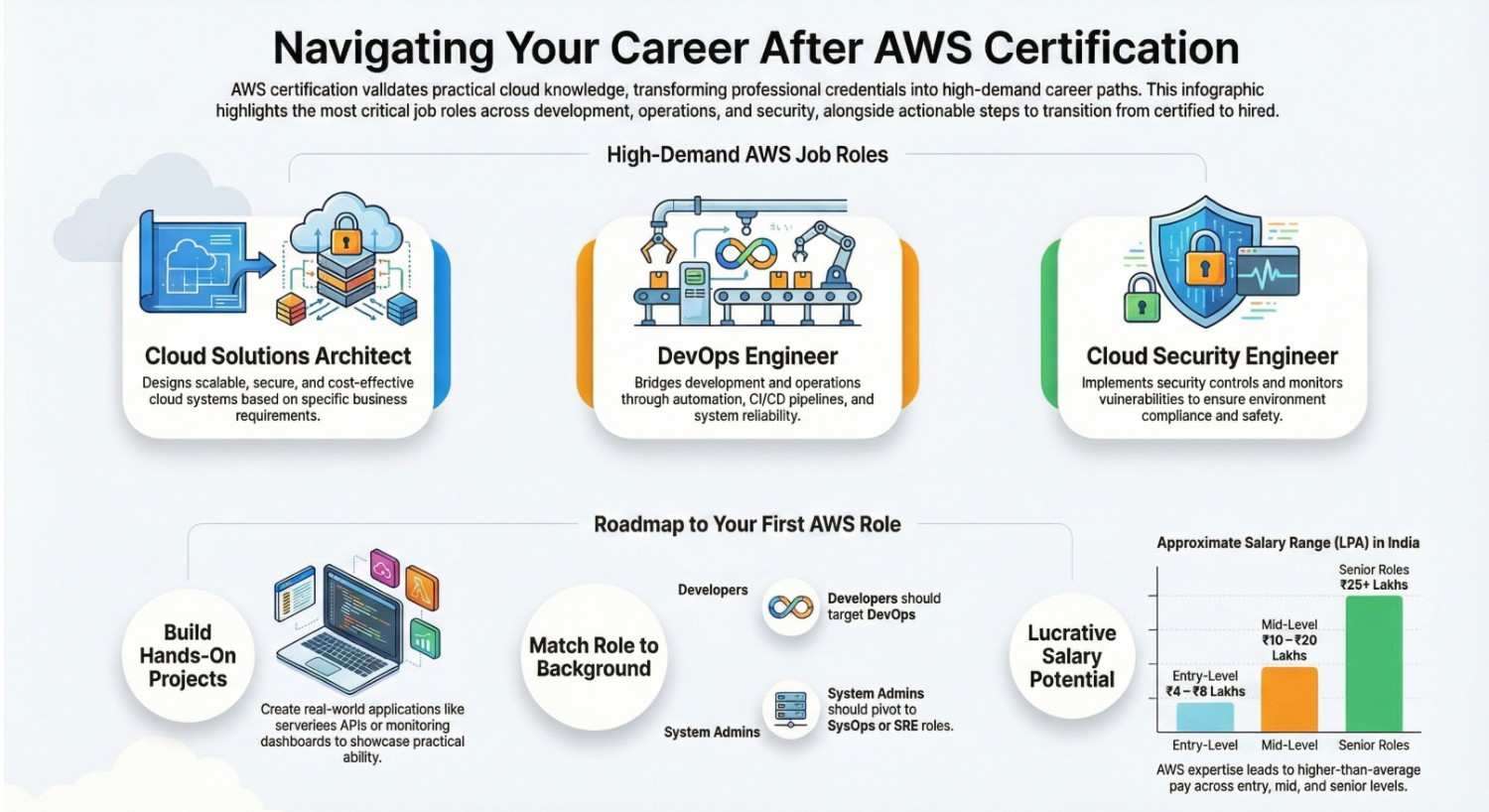
1. Cloud Solutions Architect
Role Overview
A Cloud Solutions Architect is responsible for designing scalable, secure, and cost-effective cloud systems. This is one of the most popular roles after AWS certification.
Key Responsibilities
- Design cloud architecture based on business requirements
- Select appropriate AWS services
- Ensure high availability and fault tolerance
- Optimize cost and performance
Skills Required
- Strong understanding of AWS services (EC2, S3, RDS, VPC)
- Architecture design principles
- Security best practices
- Problem-solving skills
Why It’s in Demand
Organizations need experts who can translate business needs into cloud solutions, making this role both critical and well-paid.
2. Cloud Developer
Role Overview
Cloud Developers build and deploy applications on AWS. They focus on writing code that interacts with cloud services.
Key Responsibilities
- Develop cloud-native applications
- Integrate AWS services using SDKs
- Build serverless applications
- Manage APIs and backend systems
Skills Required
- Programming (Python, JavaScript, Java)
- AWS Lambda, API Gateway
- CI/CD pipelines
- Database integration
Career Advantage
If you already have a programming background, AWS certification can help you transition into cloud-focused development roles quickly.
3. SysOps Administrator (Cloud Operations Engineer)
Role Overview
This role focuses on managing and maintaining AWS infrastructure. It’s ideal for those who enjoy monitoring, troubleshooting, and optimizing systems.
Key Responsibilities
- Monitor system performance
- Manage deployments and updates
- Handle backups and disaster recovery
- Troubleshoot system issues
Skills Required
- Cloud monitoring tools (CloudWatch)
- Networking and security basics
- Automation (scripts, Infrastructure as Code)
- Incident management
Why It’s Important
Every cloud system needs someone to keep it running smoothly, making this role essential in any organization.
4. DevOps Engineer
Role Overview
DevOps Engineers bridge the gap between development and operations. They focus on automation, continuous integration, and faster deployments.
Key Responsibilities
- Build CI/CD pipelines
- Automate infrastructure using tools like CloudFormation
- Monitor and improve deployment processes
- Ensure system reliability
Skills Required
- DevOps tools (Jenkins, Docker, Kubernetes)
- AWS services (CodePipeline, CodeBuild)
- Scripting (Python, Bash)
- Automation mindset
Career Growth
This is one of the highest-paying and fastest-growing roles in the cloud ecosystem.
5. Cloud Security Engineer
Role Overview
Cloud Security Engineers ensure that AWS environments are secure and compliant.
Key Responsibilities
- Implement security controls
- Manage IAM roles and policies
- Monitor threats and vulnerabilities
- Ensure compliance with standards
Skills Required
- AWS security services (IAM, KMS, Shield)
- Encryption techniques
- Risk assessment
- Compliance frameworks
Why It’s Critical
As cyber threats increase, companies are investing heavily in cloud security expertise.
6. Data Engineer (AWS)
Role Overview
Data Engineers work with large datasets and build pipelines for data processing using AWS services.
Key Responsibilities
- Design data pipelines
- Work with big data tools
- Manage data storage solutions
- Enable analytics and reporting
Skills Required
- AWS data services (Redshift, Glue, Athena)
- SQL and data modeling
- ETL processes
- Big data frameworks
Career Scope
With the rise of data-driven decision-making, this role is becoming increasingly valuable.
7. Cloud Consultant
Role Overview
Cloud Consultants help organizations adopt and optimize AWS solutions.
Key Responsibilities
- Analyze business requirements
- Recommend cloud strategies
- Assist in cloud migration
- Provide cost optimization advice
Skills Required
- Strong AWS knowledge
- Communication and consulting skills
- Business understanding
- Problem-solving
Unique Advantage
This role combines technical expertise with business strategy, making it ideal for experienced professionals.
8. Machine Learning Engineer (AWS)
Role Overview
This role focuses on building AI/ML models using AWS services.
Key Responsibilities
- Develop machine learning models
- Use AWS tools like SageMaker
- Deploy AI solutions
- Optimize models for performance
Skills Required
- Machine learning concepts
- Python and data science tools
- AWS ML services
- Data analysis
Future Potential
AI and ML are rapidly growing fields, and AWS plays a major role in enabling them.
9. Cloud Support Engineer
Role Overview
Cloud Support Engineers help customers troubleshoot AWS-related issues.
Key Responsibilities
- Resolve technical issues
- Assist customers with AWS services
- Monitor system health
- Provide technical guidance
Skills Required
- Strong AWS fundamentals
- Troubleshooting skills
- Communication skills
- Customer support mindset
Entry-Level Opportunity
This is a great starting role for beginners entering the cloud domain.
10. Site Reliability Engineer (SRE)
Role Overview
SREs focus on maintaining system reliability and uptime.
Key Responsibilities
- Ensure system availability
- Automate operational tasks
- Monitor system performance
- Improve reliability
Skills Required
- Monitoring tools
- Automation and scripting
- Cloud architecture
- Incident response
Why It Stands Out
This role blends software engineering with operations, making it highly specialized and rewarding.
How to Choose the Right Role
With so many options available, choosing the right role depends on your background:
- Developers: Cloud Developer, DevOps Engineer
- System Admins: SysOps Administrator, SRE
- Security Enthusiasts: Cloud Security Engineer
- Data Professionals: Data Engineer
- Beginners: Cloud Support Engineer
Tips to Land a Job After AWS Certification
Getting certified is just the first step. Here’s how to turn it into a job:
1. Build Hands-On Projects
Create real-world projects like:
- Deploying a web app on AWS
- Building a serverless API
- Setting up monitoring dashboards
2. Create a Strong Portfolio
Showcase your work on:
- GitHub
- Personal website
3. Practice Interview Questions
Prepare for:
- Scenario-based questions
- Architecture design problems
- Troubleshooting challenges
4. Gain Practical Experience
- Internships
- Freelance projects
- Open-source contributions
5. Keep Learning
AWS evolves constantly. Stay updated with:
- New services
- Best practices
- Industry trends
Salary Expectations
While salaries vary by location and experience, AWS-certified professionals often earn higher-than-average pay.
Approximate ranges:
- Entry-level: ₹4–8 LPA
- Mid-level: ₹10–20 LPA
- Senior roles: ₹25+ LPA
Global salaries can be significantly higher, especially for specialized roles like DevOps and Security Engineers.
Final Thoughts
AWS certification is more than just a credential it’s a gateway to a wide range of exciting and high-demand career paths.
Whether you want to design cloud architectures, build scalable applications, secure systems, or analyze data, there’s a role waiting for you in the AWS ecosystem.
The key is to:
- Choose the right role based on your interests
- Build practical experience
- Stay consistent in learning
With the right strategy and dedication, you can transform your AWS certification into a rewarding and future-proof career in cloud computing.
Ready to start your AWS journey?