
Cloud computing has become a foundational skill for modern IT roles, and Amazon Web Services (AWS) is one of the most widely used platforms in the industry. For beginners, AWS offers immense opportunities but it also comes with a learning curve. Many freshers jump in with enthusiasm, only to encounter avoidable mistakes that cost time, money, and confidence.
This blog explores the most common mistakes beginners make in AWS and provides practical guidance on how to avoid them. Whether you’re preparing for certifications, interviews, or real-world projects, understanding these pitfalls will accelerate your learning journey.
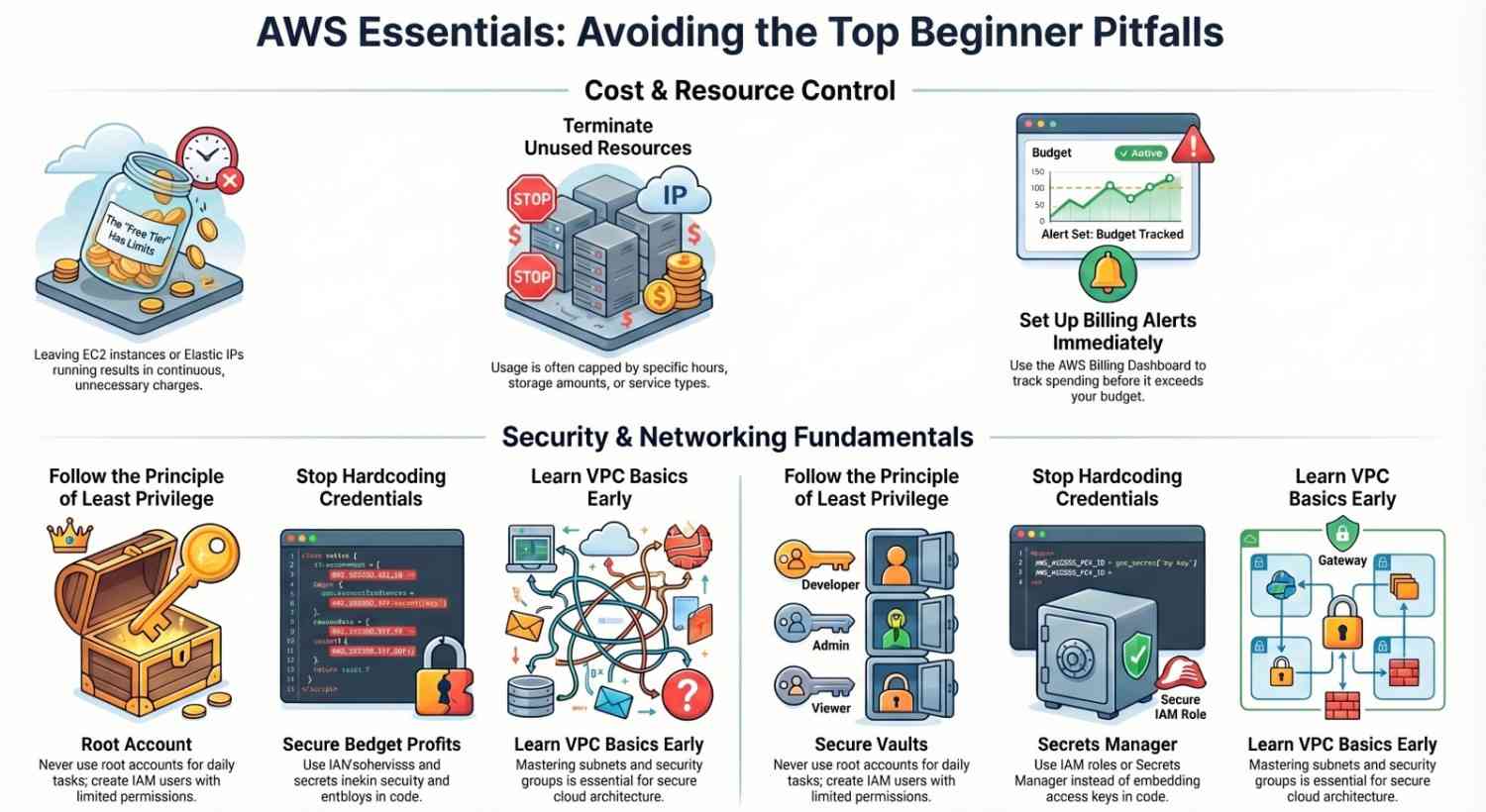
1. Ignoring the AWS Free Tier Limits
One of the biggest beginner mistakes is assuming that everything in AWS Free Tier is completely free without limits. While AWS does offer a generous free tier, it comes with restrictions such as limited hours, storage, and usage.
What goes wrong:
- Running EC2 instances continuously without tracking usage
- Using services not covered under free tier
- Forgetting to stop resources after practice
How to avoid it:
- Always check the free tier eligibility for each service
- Set up billing alerts in the AWS Billing Dashboard
- Stop or terminate resources when not in use
2. Not Understanding IAM Properly
Identity and Access Management (IAM) is the backbone of AWS security, yet beginners often overlook its importance.
What goes wrong:
- Using the root account for daily tasks
- Assigning full admin access unnecessarily
- Not using roles and policies effectively
How to avoid it:
- Never use the root account except for critical actions
- Create IAM users with limited permissions
- Follow the principle of least privilege
- Use IAM roles instead of hardcoding credentials
3. Poor Resource Management
Beginners often forget to manage or clean up resources after use, leading to unexpected charges and clutter.
What goes wrong:
- Leaving EC2 instances running
- Not deleting unused S3 buckets or snapshots
- Forgetting about Elastic IPs
How to avoid it:
- Regularly audit your resources
- Use tagging to identify and organize services
- Automate cleanup where possible
4. Choosing the Wrong Region
AWS has multiple regions worldwide, and selecting the wrong one can lead to performance issues and higher latency.
What goes wrong:
- Deploying resources far from users
- Inconsistent region usage across services
How to avoid it:
- Choose a region close to your target audience
- Stick to one region for related services unless needed
- Understand region pricing differences
5. Not Understanding Pricing Models
AWS pricing can be complex, and beginners often underestimate costs.
What goes wrong:
- Assuming all services are pay-as-you-go
- Ignoring data transfer costs
- Not using cost calculators
How to avoid it:
- Use the AWS Pricing Calculator before deploying
- Monitor billing dashboard regularly
- Understand pricing models like On-Demand, Reserved, and Spot Instances
6. Hardcoding Credentials in Code
This is a serious security mistake that many beginners make during early projects.
What goes wrong:
- Embedding access keys in source code
- Uploading credentials to GitHub
How to avoid it:
- Use environment variables
- Use IAM roles for applications
- Store secrets in AWS Secrets Manager or Parameter Store
7. Ignoring Security Best Practices
Security is a shared responsibility in AWS, but beginners often assume AWS handles everything.
What goes wrong:
- Leaving S3 buckets public
- Not enabling encryption
- Weak password policies
How to avoid it:
- Enable MFA (Multi-Factor Authentication)
- Use encryption for data at rest and in transit
- Regularly review security configurations
8. Not Learning Networking Basics (VPC)
AWS networking can be confusing at first, but ignoring it limits your understanding.
What goes wrong:
- Not understanding subnets, route tables, and gateways
- Misconfiguring security groups
How to avoid it:
- Learn VPC fundamentals early
- Practice creating custom VPC setups
- Understand public vs private subnets
9. Overcomplicating Architecture
Beginners often try to use too many services at once, leading to confusion.
What goes wrong:
- Using multiple services unnecessarily
- Designing complex architectures for simple projects
How to avoid it:
- Start simple and scale gradually
- Focus on core services first (EC2, S3, IAM)
- Avoid overengineering
10. Not Practicing Hands-On Enough
Watching tutorials is not enough AWS requires practical experience.
What goes wrong:
- Passive learning without implementation
- Lack of real-world scenarios
How to avoid it:
11. Ignoring Monitoring and Logging
Monitoring is crucial for understanding system behavior, but beginners often skip it.
What goes wrong:
- Not using logs for debugging
- Missing performance issues
How to avoid it:
- Use CloudWatch for monitoring
- Enable logging for services
- Set up alerts for critical metrics
12. Not Backing Up Data
Data loss can happen, and beginners often don’t plan for it.
What goes wrong:
- No backups for databases
- Accidental deletion of resources
How to avoid it:
- Enable automated backups
- Use snapshots for EC2 and RDS
- Store backups in multiple locations
13. Misunderstanding EC2 Instance Types
Choosing the wrong instance type can impact performance and cost.
What goes wrong:
- Over-provisioning resources
- Underestimating workload requirements
How to avoid it:
- Understand instance families (t2, m5, etc.)
- Start small and scale as needed
- Monitor usage metrics
14. Not Using Documentation Effectively
AWS documentation is extensive but often ignored.
What goes wrong:
- Relying only on tutorials
- Missing key details
How to avoid it:
- Refer to official AWS docs regularly
- Learn how to search documentation efficiently
- Use it alongside hands-on practice
15. Skipping Architecture Understanding
Many beginners focus only on services without understanding how they fit together.
What goes wrong:
- Lack of system design knowledge
- Difficulty in interviews
How to avoid it:
- Learn basic cloud architecture patterns
- Draw simple diagrams for projects
- Study real-world use cases
Final Thoughts
Making mistakes is a natural part of learning AWS, especially for beginners. However, being aware of these common pitfalls can save you time, reduce costs, and improve your confidence.
Instead of trying to master everything at once, focus on building a strong foundation:
- Learn core services deeply
- Practice consistently
- Build real-world projects
- Follow best practices from the beginning
Remember, AWS is not just about knowing services it’s about understanding how to use them efficiently, securely, and cost-effectively.
If you avoid these common mistakes early in your journey, you’ll not only stand out as a fresher but also build a strong base for advanced cloud skills in the future.
Start small, stay consistent, and keep building.
- Ready to explore AWS? Click here to get started!