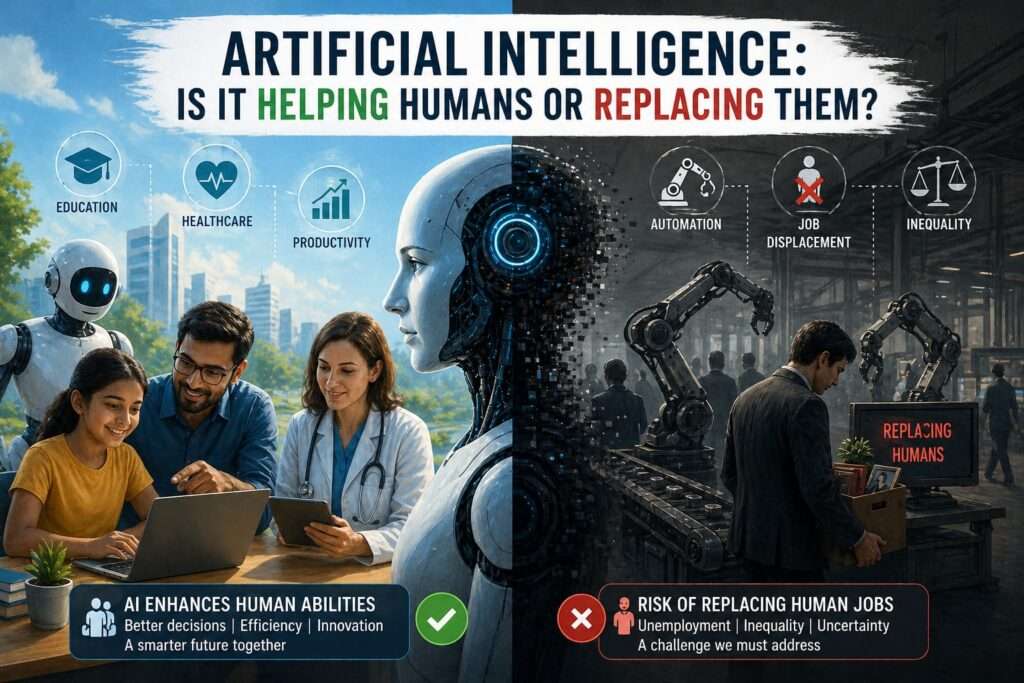
Artificial Intelligence (AI) is no longer a futuristic concept—it is a present-day reality that is rapidly transforming the way we live, work, and interact. From voice assistants on our phones to advanced systems in healthcare and finance, AI has become deeply integrated into our daily lives. However, with this rapid growth comes an important question: Is AI helping humans, or is it slowly replacing them?
What is Artificial Intelligence?
Artificial Intelligence refers to the ability of machines to mimic human intelligence. This includes learning from data, recognizing patterns, making decisions, and improving over time without explicit programming.
Some common examples of AI include:
- Voice Assistants (Siri, Alexa)
Ex:
You can say “Hey Siri, set an alarm for 6 AM,” and it will set the alarm automatically.
Or say “Alexa, play music,” and it will start playing songs. - Recommendation Systems (YouTube, Netflix)
Ex:
If you watch cooking videos on YouTube, it will suggest more cooking videos.
If you watch action movies on Netflix, it will recommend similar movies. - Chatbots (Customer Support)
Ex:
When you visit a shopping website and ask, “Where is my order?”, the chatbot replies instantly with tracking details. - Self-Driving Vehicles
Ex:
Cars made by Tesla can drive themselves using autopilot features, controlling speed and direction. - Fraud Detection (Banking)
Ex:
If someone tries to make a suspicious transaction from a different country, the bank system may block it and send you an alert.
How AI is Helping Humans
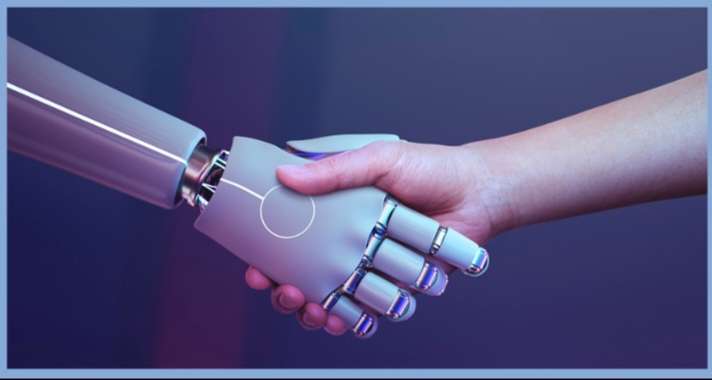
I has brought significant advantages across multiple industries. It is not just about automation—it is about enhancement.
1. Increased Efficiency and Productivity
AI can handle repetitive and time-consuming tasks much faster than humans. This allows employees to focus on more important and creative work.
2. Improved Decision-Making
AI systems can analyze large amounts of data quickly, helping professionals make better decisions. For example, in healthcare, AI helps doctors diagnose diseases more accurately.
3. Personalization
AI enhances user experience by providing personalized recommendations based on individual preferences.
4. 24/7 Availability
Unlike humans, AI systems can work continuously without breaks. Customer service chatbots, for instance, can assist users at any time.
5. Innovation in Various Fields
AI is driving innovation in areas like education, agriculture, robotics, and climate science, helping solve complex global challenges
Is AI Replacing Humans?
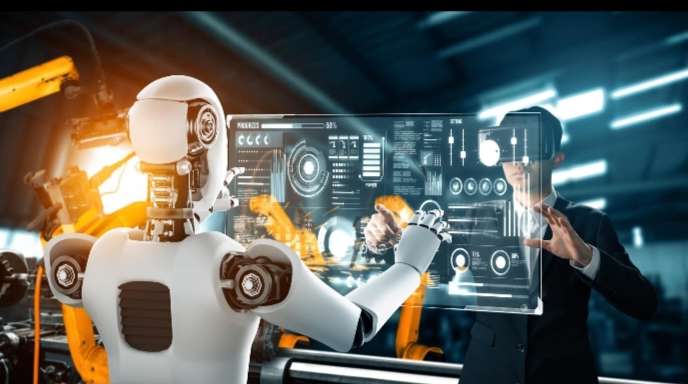
While AI offers many benefits, it also raises concerns about job displacement and increasing dependence on technology.
1. Job Automation
Artificial Intelligence is transforming how work is performed, especially in industries that rely on repetitive and routine tasks. Jobs such as data entry, basic customer support, and manufacturing line work are increasingly being automated through AI-powered systems. These technologies can operate faster, with greater accuracy, and without fatigue, making them more efficient than humans in certain roles. While this boosts productivity and reduces operational costs for businesses, it also raises serious concerns about unemployment and job displacement for workers who depend on these roles for their livelihood.
2. Skill Gap
As AI continues to evolve, the demand for advanced and specialized skills is growing rapidly. Competencies such as data analysis, programming, machine learning, and critical thinking are becoming essential in today’s job market. However, access to quality education and training is not equal for everyone, leading to a widening skill gap. Individuals who are unable to upgrade their skills may struggle to find employment, increasing inequality in job opportunities. Continuous learning and upskilling are therefore crucial to remain competitive in an AI-driven world.
3. Over-Reliance on Technology
The growing dependence on AI systems for decision-making has raised concerns about over-reliance on technology. Organizations increasingly use AI to analyze data, predict outcomes, and even make critical decisions. While this can enhance efficiency, excessive reliance may reduce human judgment and critical thinking. This becomes particularly risky when AI systems fail, produce inaccurate results, or rely on biased data. In sensitive sectors such as healthcare, finance, and law, such errors can have serious consequences. Hence, human oversight remains essential.
4. Ethical Concerns
AI introduces several ethical challenges that must be carefully addressed. One key issue is data privacy, as AI systems require large volumes of personal data, which may be misused or accessed without proper consent. Another concern is algorithmic bias, where AI systems may produce unfair or discriminatory outcomes due to biased training data. Additionally, many AI models lack transparency, making it difficult to understand how decisions are made. This lack of accountability can reduce trust in AI systems. Addressing these ethical concerns is critical to ensure that AI is developed and used responsibly for the benefit of society.
AI raises important ethical issues such as data privacy, algorithmic bias, and lack of transparency.
The Future: Collaboration, Not Replacement
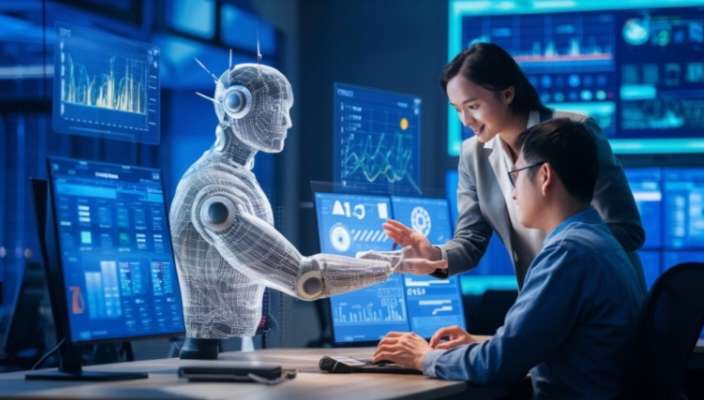
Despite these concerns, AI is unlikely to completely replace humans. Instead, it will transform the nature of work.
The future lies in human-AI collaboration:
- AI will handle repetitive and data-heavy tasks
- Humans will focus on creativity, emotional intelligence, and critical thinking
For example:
- In healthcare, AI can analyze medical data, but doctors make final decisions
- In business, AI provides insights, but leaders make strategic choices
What Should We Do?
To stay relevant in the AI era, individuals must adapt and grow.
✔ Learn new skills such as problem-solving, communication, and digital literacy
✔ Stay updated with the latest technological developments
✔ Embrace AI as a tool rather than fearing it
✔ Focus on uniquely human strengths like creativity and empathy
Conclusion
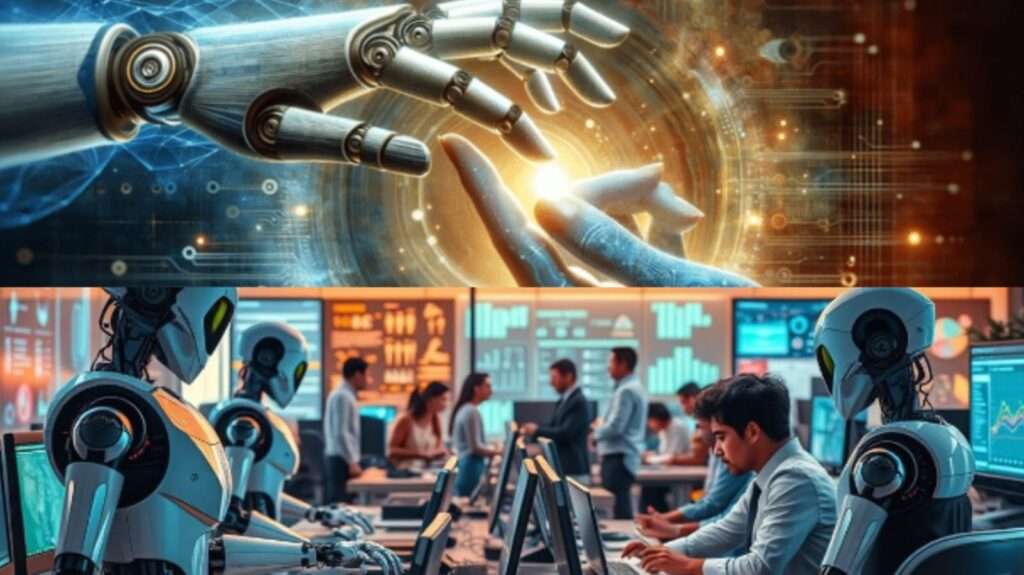
Artificial Intelligence is not our enemy — it is our greatest ally.
AI isn’t here to steal our future. It’s here to amplify it — to make us smarter, faster, and more capable than ever before.
Yes, some jobs will change. Some will disappear.
But new opportunities will emerge — opportunities we can’t even fully imagine yet.
So the real question isn’t: “Will AI replace us?”
The real question is: “Are you ready to rise with it?”
Because those who learn, adapt, and evolve won’t just survive — they will lead.
And those who resist change risk being left behind.
AI is just a tool.
And like every powerful tool in history, its impact depends on the people who use it.
So—
✅ Learn continuously
✅ Embrace technology
✅ Stay curious
✅ And double down on what makes us human: creativity, empathy, and leadership
The future doesn’t belong to AI.
It belongs to people who know how to work with it.
And that future starts with you.