

Introduction
Cloud computing is no longer a “nice-to-have” skill it’s a career-defining decision. As companies accelerate digital transformation, professionals are asking one critical question:
AWS vs Azure: which cloud pays more in 2026?
Both Amazon Web Services (AWS) and Microsoft Azure dominate the cloud market, offer lucrative salaries, and power millions of enterprise workloads worldwide. But when it comes to salary potential, job demand, certifications, and long-term career growth, the answer isn’t as simple as picking the biggest provider.
In this in-depth guide, we’ll break down:
- AWS vs Azure salary comparison in 2026
- Entry-level, mid-level, and senior cloud salaries
- Role-based pay (Cloud Engineer, DevOps, Architect)
- Certification impact on salary
- Job market demand and future trends
- Which cloud platform is better for your career
Whether you’re a fresher, experienced IT professional, or career switcher, this article will help you make a smart, future-proof decision.
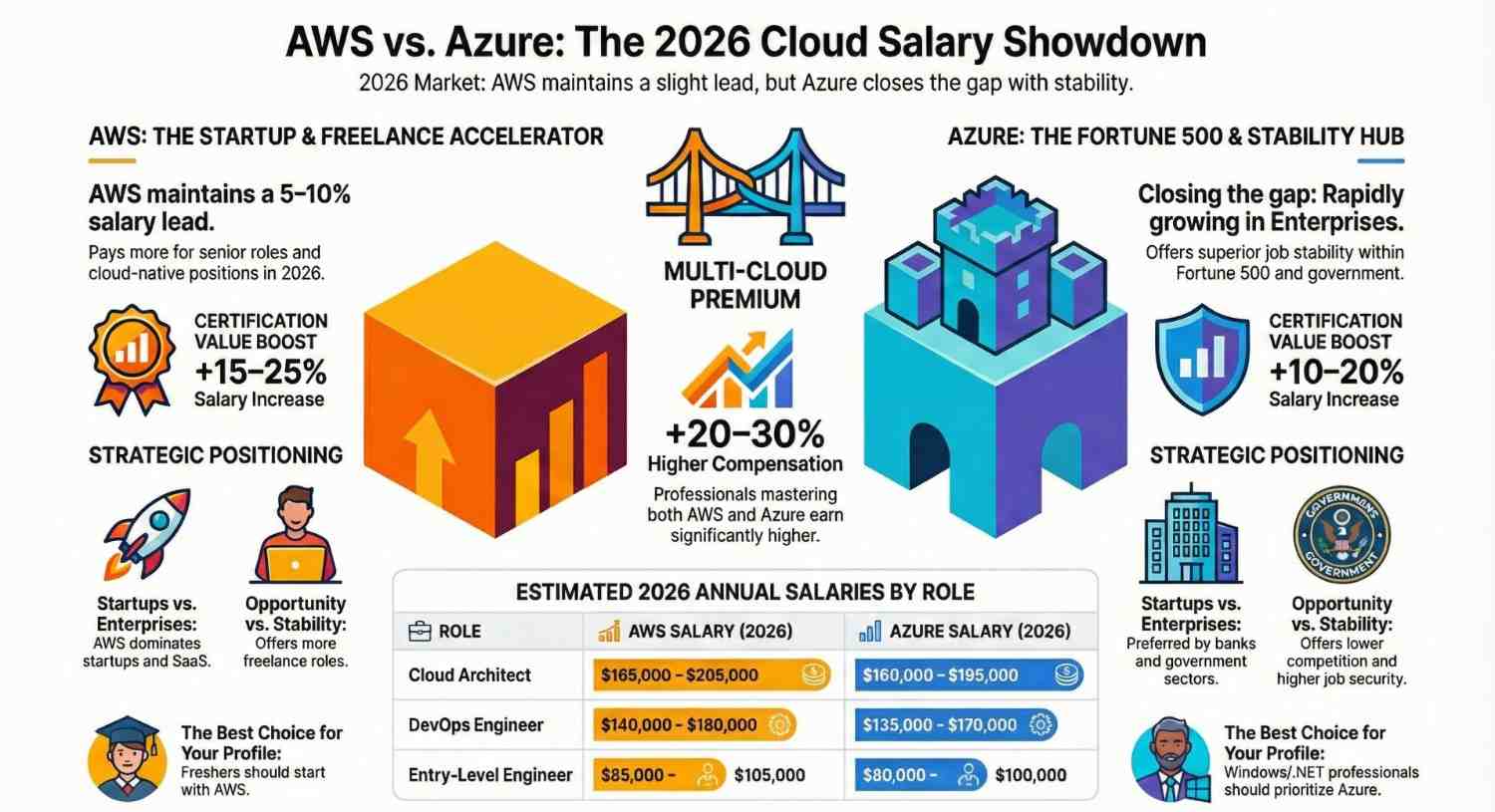
AWS vs Azure: Quick Overview
What Is AWS?
Amazon Web Services (AWS) is the world’s largest cloud service provider, holding the biggest market share globally. It offers over 200 services across computing, storage, networking, AI, and DevOps.
Key AWS strengths:
- Massive global adoption
- Startup and enterprise dominance
- High-paying freelance and contract roles
- Deep service ecosystem
What Is Azure?
Microsoft Azure is the second-largest cloud platform, deeply integrated with Microsoft products like Windows Server, Active Directory, Office 365, and Power BI.
Key Azure strengths:
- Strong enterprise and government adoption
- Preferred choice for Microsoft-based companies
- Easier learning curve for Windows/.NET professionals
- Rapid growth in corporate cloud migration
AWS vs Azure Salary Comparison in 2026 (Global Overview)
Let’s get to the big question.
Average Annual Salary (2026 Estimates)
| Role | AWS Salary | Azure Salary |
|---|---|---|
| Entry-Level Cloud Engineer | $85,000 – $105,000 | $80,000 – $100,000 |
| Mid-Level Cloud Engineer | $120,000 – $145,000 | $115,000 – $140,000 |
| Senior Cloud Engineer | $150,000 – $185,000 | $145,000 – $175,000 |
| Cloud Architect | $165,000 – $205,000 | $160,000 – $195,000 |
| DevOps Engineer | $140,000 – $180,000 | $135,000 – $170,000 |
👉 AWS still pays slightly more on average, especially at senior and architect levels.
👉 Azure salaries are closing the gap fast, particularly in enterprise-heavy regions.
AWS vs Azure Salaries by Experience Level
Entry-Level & Freshers (0–2 Years)
For beginners, AWS has more entry-level opportunities, especially in startups and SaaS companies.
- AWS fresher salary: $85K–$105K
- Azure fresher salary: $80K–$100K
Winner: AWS
Why: More junior roles, labs, tutorials, and community support.
Mid-Level Professionals (3–6 Years)
At this stage, specialization matters more than platform choice.
- AWS professionals with DevOps + Terraform earn significantly more
- Azure professionals in enterprise IT see stable growth
Winner: Slight AWS edge, but Azure offers stability and faster promotions.
Senior & Architect Roles (7+ Years)
This is where enterprise influence kicks in.
- AWS dominates startups, SaaS, and cloud-native companies
- Azure dominates banks, governments, healthcare, and Fortune 500 firms
Result: Salaries are nearly equal at the top but AWS has more freelance and consulting income potential.
AWS vs Azure Salary by Job Role
Cloud Engineer
AWS engineers typically earn 5–10% more, due to higher demand in cloud-native companies.
DevOps Engineer
AWS + Kubernetes + CI/CD pays extremely well.
Azure DevOps professionals shine in Microsoft-based enterprises.
Verdict: AWS slightly higher, Azure more consistent.
Cloud Architect
Azure architects in large enterprises can match or exceed AWS salaries, especially in regulated industries.
Verdict: Tie (context matters more than platform).
AWS vs Azure Certification Salary Impact
Certifications still matter in 2026 especially for visibility and promotions.
Top AWS Certifications
- AWS Solutions Architect – Professional
- AWS DevOps Engineer – Professional
- AWS Security Specialty
Salary boost: 15–25%
Top Azure Certifications
- Azure Solutions Architect Expert
- Azure DevOps Engineer Expert
- Azure Security Engineer
Salary boost: 10–20%
AWS certifications slightly outperform, but Azure certs are preferred in corporate environments.
AWS vs Azure Job Demand in 2026
AWS Job Market
- Strong in startups, SaaS, AI, Web3, and cloud-native apps
- High freelance and contract demand
- More roles, more competition
Azure Job Market
- Exploding demand in enterprises
- Government and regulated sectors prefer Azure
- Lower competition, higher job security
AWS = opportunity-heavy
Azure = stability-heavy
Regional Salary Comparison
United States & Canada
AWS pays marginally more, especially in tech hubs.
Europe
Azure demand is rising fast due to enterprise cloud adoption.
India & Asia
AWS has more jobs, but Azure roles often pay better in MNCs.
Remote Jobs
AWS dominates the remote-first job market.
AWS vs Azure: Long-Term Career Growth
AWS Career Growth
- Faster skill diversification
- Strong for entrepreneurs and consultants
- Ideal for multi-cloud careers
Azure Career Growth
- Faster promotions in enterprises
- Easier leadership and management transitions
- Strong alignment with Microsoft ecosystem
Multi-Cloud = The Real Salary Booster
In 2026, professionals who know both AWS and Azure earn the most.
- AWS + Azure = 20–30% higher compensation
- Multi-cloud architects are in short supply
- Large companies are actively avoiding vendor lock-in
AWS vs Azure: Which Cloud Pays More in 2026?
Final Verdict
- AWS pays more on average, especially for:
- Startups
- Freelancing
- Cloud-native roles
- Azure offers comparable pay with:
- Better job stability
- Faster enterprise growth
- Lower competition
Best Choice Based on Your Profile
- Freshers: AWS
- Windows/.NET professionals: Azure
- Freelancers: AWS
- Enterprise IT professionals: Azure
- Maximum salary: Learn both
Conclusion
The AWS vs Azure salary debate in 2026 has no single winner. AWS still leads in raw pay, but Azure is rapidly catching up and in some enterprise roles, already matching or exceeding AWS salaries.
The smartest move?
Start with one cloud, then go multi-cloud.
In the long run, skills + experience > platform choice.
- For more information about AWS and Azure you can refer to Jeevi’s Page.
- This tutorial is just the beginning learn Cloud Computing hands-on in our complete course. Upgrade your skills.




