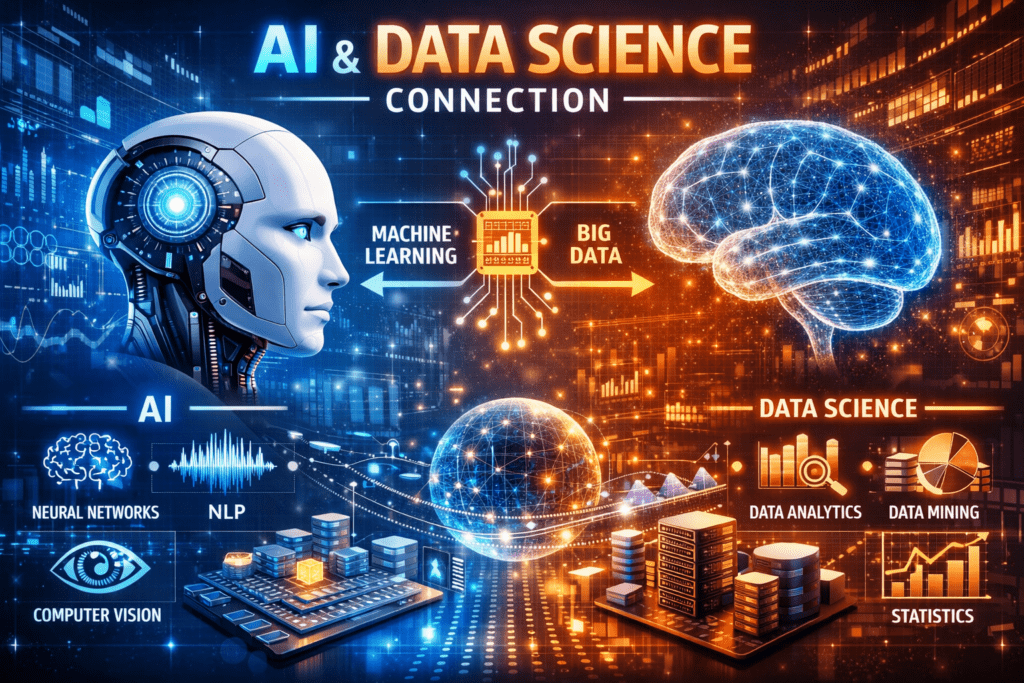
Think of data science and AI as two close collaborators building something powerful together 🔧🤖
Data science is like the explorer. It collects, cleans, and understands data.
AI is like the decision-maker. It uses that understanding to act, predict, or automate.
Hook: Data is everywhere, but turning it into intelligence requires more than just numbers.
Brief overview: Explain that data science and AI are closely linked, often overlapping but serving different purposes.
Thesis: Show how AI builds on data science to create intelligent systems.
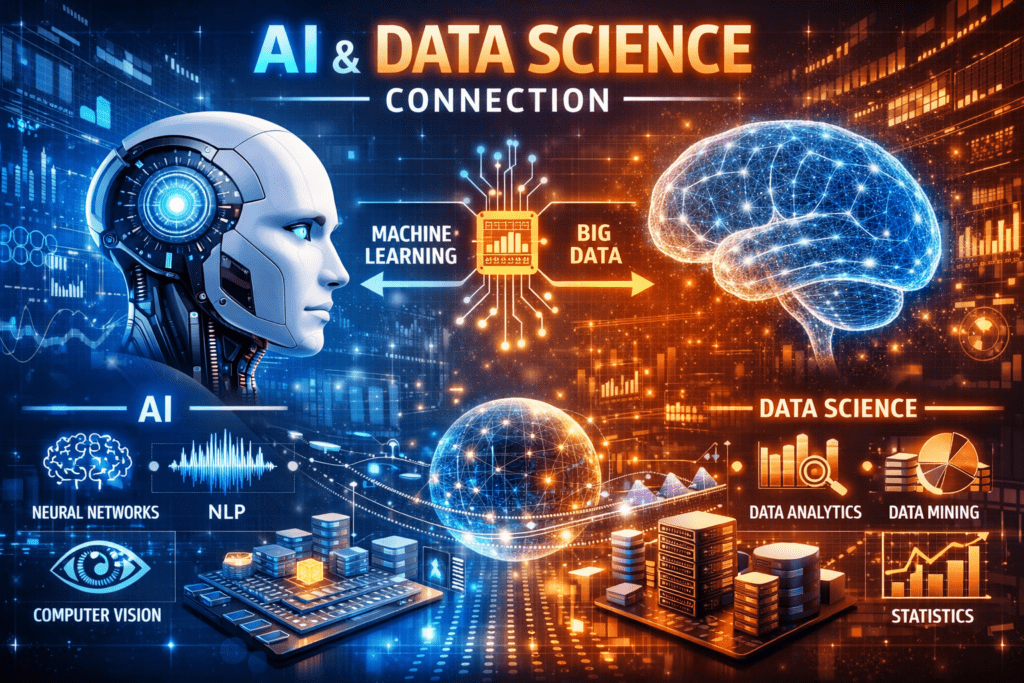
Explanation for DS and AI
1.What is datascience?
Data Science is a multidisciplinary field that combines mathematics, statistics, programming, machine learning, and domain expertise to extract actionable insights from structured and unstructured data . It enables organizations to analyze trends, predict outcomes, and make data-driven decisions across industries such as healthcare, finance, e-commerce, and transportation. Key roles: Data Scientist, Data Analyst, ML Engineer.
Applications in daily life:
- Healthcare: Disease prediction, medical image analysis, personalized treatment.
- Finance: Fraud detection, credit scoring, algorithmic trading.
- Retail & E-commerce: Product recommendations, demand forecasting, inventory optimization.
Challenges and Risks:
- Data Quality: Incomplete, inconsistent, or biased datasets reduce accuracy.
- Integration Issues: Combining data from multiple sources is complex.
- Interpretability: Advanced models are often “black boxes,” making decisions hard to explain.
- Privacy Concerns: Sensitive data can be misused or leaked.
- Bias & Fairness: Algorithms may reinforce discrimination if trained on biased data.
- Legal & Compliance: Regulations like GDPR make handling data more complex.
2.What is Artificial Intelligence (AI)?
Artificial Intelligence (AI) is the science and engineering of creating computer systems that can perform tasks requiring human-like intelligence, such as learning, reasoning, problem-solving, and decision-making. In simple terms, it enables machines to mimic cognitive functions that humans associate with the mind.
Applications in daily life:
- Virtual Assistants: Siri, Alexa, Google Assistant.
- Healthcare: AI-powered diagnostics, drug discovery.
- Transportation: Autonomous vehicles.
- Entertainment: Personalized recommendations on Netflix or Spotify.
- Business: Fraud detection, predictive analytics, customer support chatbots.
Challenges and Risks:
- Ethical Concerns: Bias in algorithms, privacy issues.
- Job Displacement: Automation replacing certain human roles.
- AI Safety: Risks of misuse, unintended consequences, and debates around regulation.
Now let’s connect the dots clearly:
1. Data science feeds AI
- AI systems don’t magically “know” things. They learn from data.
- Data science gathers and prepares data
- Without clean, structured data → AI is basically blind
- Data Collection & Cleaning: AI systems need large, high-quality datasets. Data science ensures raw data is cleaned, structured, and ready for training.
- Feature Engineering: Data scientists identify the most relevant variables (features) that AI models use to make accurate predictions.
- Model Building: Machine learning and deep learning—core AI techniques—are part of data science workflows.
- Automation: AI automates repetitive data science tasks like sorting, cleaning, and anomaly detection, making the process faster and more efficient.
- Decision Support: AI models trained with data science methods provide predictive analytics, recommendations, and risk assessments.
- Example: If you want an AI to predict exam results, data science first organizes past student scores, attendance, etc.
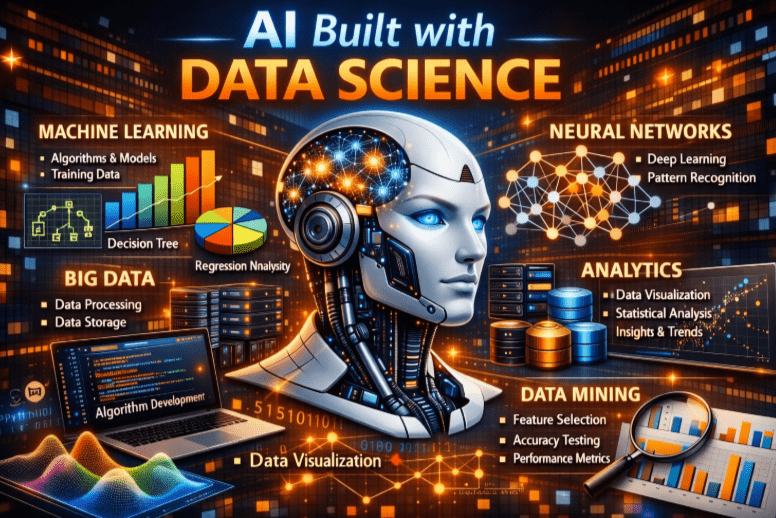
2. AI is built using data science techniques
- AI models (especially machine learning) are actually part of data science.
- Data science includes statistics + programming + machine learning
- AI uses these models to learn patterns.
- What data science does?
- Data science gathers and prepares the raw ingredients:
- Collects data (numbers, images, text, clicks…)
- Cleans it (removes noise, errors)
- Analyzes patterns (finding trends and relationships)
- 🤖 What AI does?
- AI uses those prepared ingredients to “learn”:
- Builds models using techniques like machine learning
- Learns patterns from the data
- Makes decisions or predictions automatically
- 🧠 How they connect?
- AI doesn’t magically appear. It’s trained using data science methods:
- Data science → prepares and structures data
- AI → learns from that data and acts intelligently
- Example: A recommendation system (like Netflix or Amazon) is built using data science methods, but we call the final system “AI”
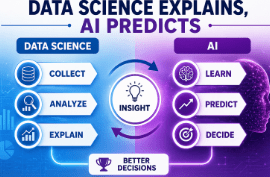
3. Data science explains, AI predicts
- They have slightly different focus:
- Data science → “What happened and why?”
- AI → “What will happen next?”
- 🧩 “Data Science explains, AI predicts”
- 1) Data Science = understanding the world through data
It doesn’t just “look at data.” It interrogates it.
Descriptive: What happened? (reports, dashboards)
Diagnostic: Why did it happen? (correlation, root cause)
Exploratory: What patterns exist that we didn’t expect?
It uses:
Statistics (hypothesis testing, distributions)
Data cleaning & preprocessing
Visualization (turning chaos into clarity)
👉 Output: insight + structured data
2) AI = turning understanding into action
AI takes those insights and builds systems that behave intelligently.
Learns patterns using machine learning
Generalizes from past data to unseen situations
Automates decisions
It uses:
Algorithms (decision trees, neural networks, etc.)
Training + testing process
Optimization (improving accuracy)
👉 Output: predictions + decisions
- 1) Data Science = understanding the world through data
- Example:
- Data science: analyzes why sales dropped
- AI: predicts future sales and suggests actions
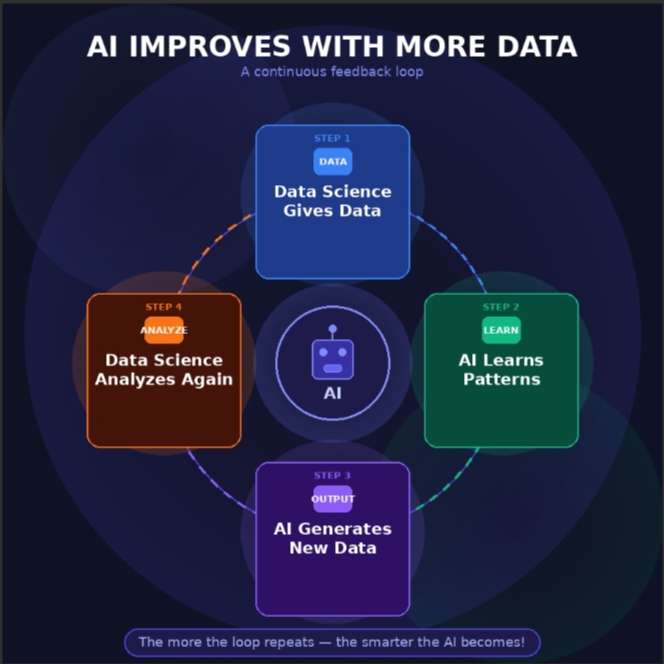
4. AI improves with more data (loop!)
- Here’s the cool part:
- Data science gives data → AI learns
- AI makes predictions → generates new data
- Data science analyzes again → improves AI
- It’s like a feedback loop 🔄 getting smarter over time
- Why More Data Helps
Better pattern recognition → AI sees clearer relationships
Reduced errors → less chance of wrong predictions
Handles variety → learns different situations
Improves generalization → works well on new data
||🔹 Learning Process
Data is collected
AI model is trained
Patterns are learned
Predictions are made
New data improves the model 🔄
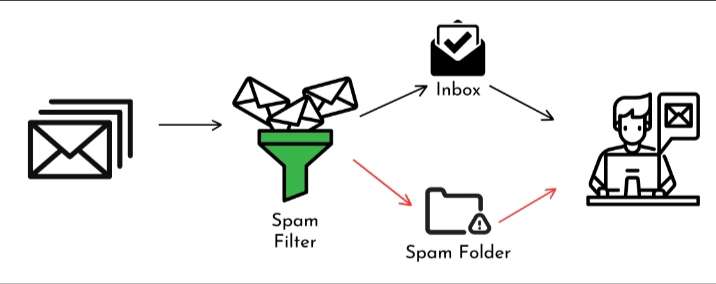
🎯 Simple real-life example:
- Take a spam email filter:
- Data science: collects emails, labels spam vs not spam
- AI: learns patterns from that data
- Result: AI automatically blocks spam in the future
🧩 One-line connection
Data science builds the brain’s knowledge, AI uses that knowledge to act intelligently.
Comparison table with datascience and AI roles:
| Aspect | Data science | Artificial Intelligence |
| Role | Collects, Cleans, analyzes data | Learn from data and makes decisions |
| Focus | Understanding past & present | Predicting future outcomes |
| Example | Labels emails as spam/not spam | Detects and blocks spam |