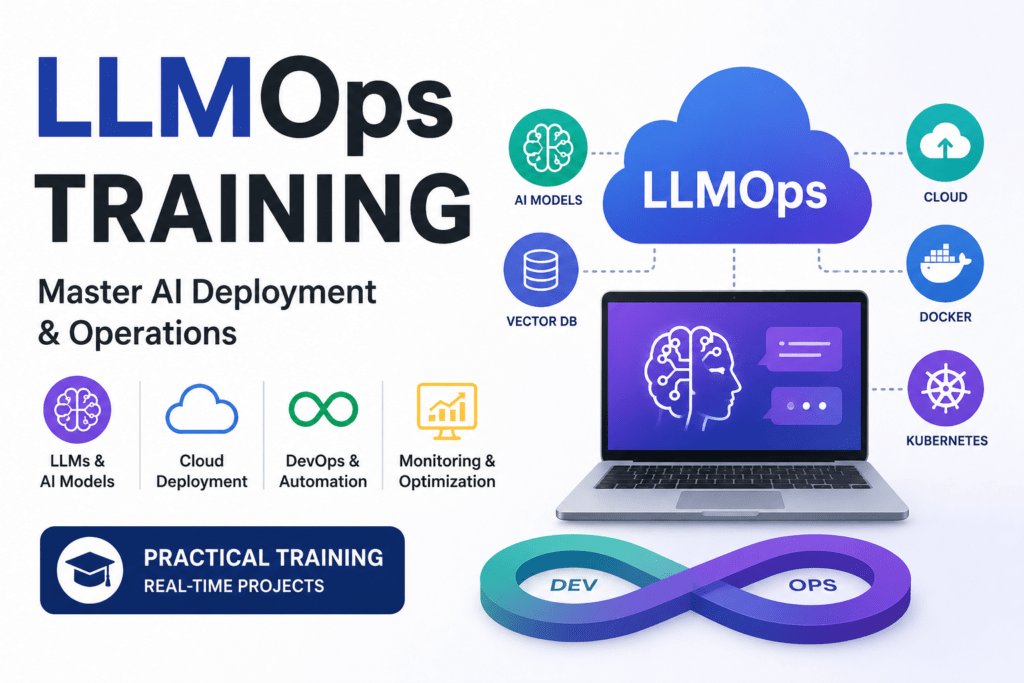
Artificial Intelligence is evolving rapidly, and Large Language Models (LLMs) are now powering chatbots, copilots, automation platforms, enterprise search systems, and AI-driven applications across industries. But building an AI demo is very different from deploying a reliable production-ready AI system.
This is where LLMOps becomes important.
LLMOps (Large Language Model Operations) combines AI engineering, MLOps, DevOps, data pipelines, monitoring, security, and deployment practices to help teams build scalable and reliable AI applications.
A structured LLMOps learning path helps developers understand not only how to use AI models, but also how to deploy, monitor, secure, and continuously improve them in real-world environments.
What is LLMOps?
LLMOps is the process of managing the complete lifecycle of AI applications powered by Large Language Models.
It includes:
- Prompt engineering
- RAG (Retrieval-Augmented Generation)
- Vector databases
- API integration
- Data pipelines
- Evaluation frameworks
- Deployment strategies
- Monitoring and observability
- Security and governance
- CI/CD for AI systems
Modern companies are actively hiring engineers who can manage production-grade AI systems instead of just creating prototypes.
Foundations of LLMOps
The first step in learning LLMOps is understanding how LLM applications actually work.
Module 1 — LLMOps Foundations
This stage focuses on core concepts such as:
- What Large Language Models are
- How prompts work
- Inputs and outputs
- Context windows
- Token usage
- Difference between demos and production AI systems
Understanding these fundamentals creates a strong base for building scalable AI applications.
Module 2 — Build Your First LLM App
Once the basics are clear, the next step is building an actual AI application.
Learners typically work with:
- LLM APIs
- Prompt templates
- Input/output validation
- Error handling
- Basic AI workflows
This stage introduces practical AI development using real tools and APIs.
Module 3 — Adding RAG (Retrieval-Augmented Generation)
RAG is one of the most important concepts in modern AI systems.
Instead of relying only on model memory, RAG allows applications to retrieve information from external knowledge sources before generating responses.
Topics usually include:
- Document chunking
- Embeddings
- Vector databases
- Similarity search
- Knowledge retrieval pipelines
RAG significantly improves AI accuracy and enables domain-specific AI assistants.
Building Production AI Systems
After learning the basics, the next phase focuses on creating scalable and reliable AI infrastructure.
Module 4 — Data Ingestion Pipelines
AI systems require constantly updated knowledge sources.
This module covers:
- Data ingestion workflows
- Dataset versioning
- Safe updates
- Pipeline reliability
- Automation processes
Proper ingestion pipelines ensure AI systems remain accurate and up to date.
Module 5 — Evaluation Frameworks
One of the biggest challenges in AI engineering is measuring output quality.
Evaluation systems help teams determine:
- Response quality
- Retrieval accuracy
- Hallucination detection
- Model reliability
- Performance benchmarks
This stage teaches how to systematically evaluate AI applications instead of relying on manual testing alone.
Module 6 — Production Serving
Deploying AI applications for real users requires more than just API calls.
Production serving includes:
- Multi-turn conversation handling
- Latency optimization
- State management
- Guardrails and safety systems
- Scalable deployment architecture
This phase introduces the operational side of AI engineering.
Operating and Scaling AI Systems
Modern AI platforms need continuous monitoring, deployment automation, and security controls.
Module 7 — CI/CD and Release Engineering
LLMOps integrates DevOps practices into AI deployment pipelines.
Key topics include:
- Automated deployment workflows
- Versioned model releases
- Canary deployments
- Rollback strategies
- Continuous integration pipelines
This helps organizations deploy AI systems safely and efficiently.
Module 8 — Observability and Feedback Loops
AI applications need continuous monitoring after deployment.
Observability focuses on:
- Logs and metrics
- User feedback analysis
- Performance tracking
- System monitoring
- Continuous improvement loops
Monitoring helps teams improve response quality and maintain reliability.
Module 9 — Security and Governance
Security is critical when working with enterprise AI systems
This module includes:
- Authentication and authorization
- Secret management
- Rate limiting
- PII handling
- Governance policies
- Responsible AI practices
Organizations require secure AI systems that comply with industry standards and regulations.
Capstone Project — Build a Complete LLMOps System
The final stage combines all concepts into a complete production-ready AI application.
Students typically build systems involving:
- Data ingestion
- Retrieval pipelines
- Evaluation frameworks
- Stateful conversations
- Deployment workflows
- Monitoring systems
- Security implementation
This hands-on experience helps learners gain practical industry-level skills.
Why Learn LLMOps?
LLMOps is becoming one of the most valuable skills in the AI industry because companies need engineers who can manage real-world AI infrastructure.
Career opportunities include:
- AI Engineer
- LLMOps Engineer
- AI Platform Engineer
- GenAI Developer
- MLOps Engineer
- AI Infrastructure Engineer
- DevOps + AI Specialist
As AI adoption grows, professionals with LLMOps expertise will continue to be in high demand.
Final Thoughts
Learning LLMOps is not just about using AI models. It is about understanding how to build reliable, scalable, secure, and production-ready AI systems.
A structured roadmap covering foundations, RAG pipelines, deployment, evaluation, observability, CI/CD, and governance provides the practical knowledge needed for modern AI engineering roles.
For developers, DevOps engineers, cloud professionals, and AI enthusiasts, LLMOps offers a powerful path into the future of AI infrastructure and intelligent application development.