Search Engine Optimization (SEO) has never been static but by 2026, the landscape has evolved faster than ever. With advances in AI, changing user behavior, and constant algorithm updates from Google, what worked just a few years ago may no longer deliver results today.
If you’re a blogger, developer, marketer, or business owner, understanding what’s changed and what still works is critical to staying competitive.
Let’s break it down.
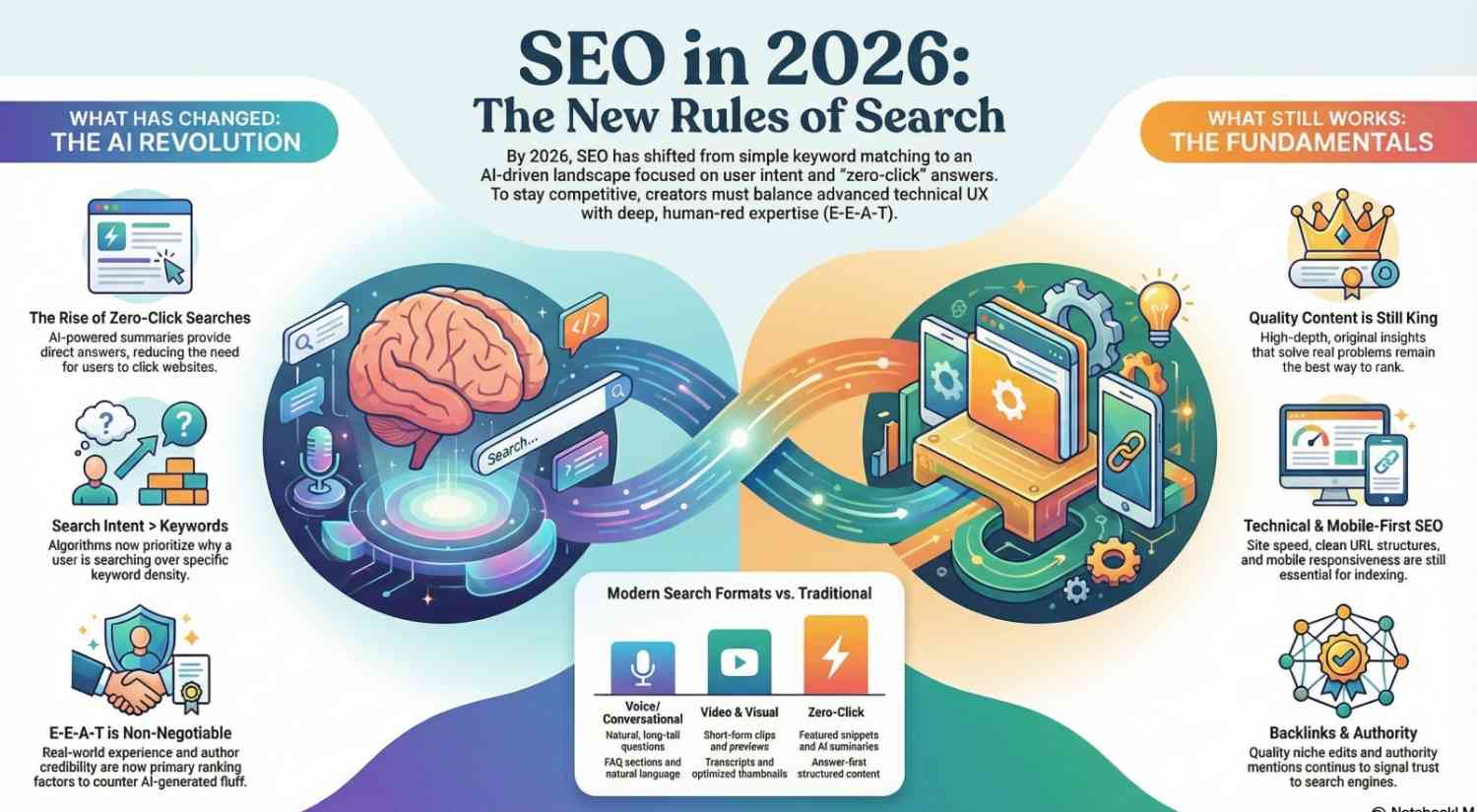
What Has Changed in SEO in 2026
1. AI-Driven Search is Dominating
Search is no longer just about keywords it’s about intent and context.
With AI-powered systems like Google Search Generative Experience, users often get direct answers without clicking websites.
What this means:
- Fewer clicks, more zero-click searches
- Content must be highly valuable and unique
- Ranking alone isn’t enough you must capture attention instantly
Adaptation tip:
Focus on answer-first content clear, concise, and structured.
2. Search Intent > Keywords
Keyword stuffing is long dead. In 2026, search intent is everything.
Google understands:
- Why a user is searching
- What format they expect (blog, video, tool)
- Whether your content satisfies that need
Types of intent:
- Informational
- Transactional
- Navigational
- Commercial
Adaptation tip:
Create content that perfectly matches intent, not just keywords.
3. EEAT is More Important Than Ever
Google’s E-E-A-T principle (Experience, Expertise, Authoritativeness, Trustworthiness) is now a major ranking factor.
What’s new:
- Real-world experience matters more than generic content
- Author credibility is evaluated deeply
- Fake or AI-only content struggles to rank
Adaptation tip:
- Add author bios
- Include real examples, screenshots, or case studies
- Show proof of expertise
4. Rise of Voice & Conversational Search
With smart assistants and mobile usage increasing, voice search is now mainstream.
People search like:
“What’s the best way to improve SEO in 2026?”
instead of:
“SEO tips 2026”
Adaptation tip:
- Use natural language
- Add FAQ sections
- Optimize for long-tail conversational queries
5. Video & Visual SEO is Exploding
Platforms like YouTube, Instagram, and short-form video apps are dominating search results.
Google now shows:
- Videos in SERPs
- Visual previews
- Short clips
Adaptation tip:
- Embed videos in blogs
- Use optimized thumbnails
- Add transcripts for SEO
6. Core Web Vitals & UX Are Ranking Factors
User experience is no longer optional.
Metrics like:
- Page speed
- Interactivity
- Visual stability
are critical.
These are part of Core Web Vitals.
Adaptation tip:
- Optimize loading speed
- Use clean UI/UX
- Avoid intrusive popups
7. AI Content is Everywhere (But Not Always Effective)
AI tools have made content creation easy but also flooded the internet with low-quality posts.
Google can detect:
- Thin AI content
- Repetitive articles
- Lack of originality
Adaptation tip:
Use AI as a tool, not a replacement. Add:
- Personal insights
- Unique data
- Real-world examples
What Still Works in SEO (And Always Will)
Despite all the changes, some fundamentals remain powerful.
1. High-Quality Content Still Wins
No matter how advanced algorithms get, content is still king.
But in 2026, “quality” means:
- Depth and clarity
- Original insights
- Actionable value
Focus on:
- Solving real problems
- Writing in simple language
- Structuring content well
2. Backlinks Still Matter
Links are still a strong ranking signal.
But now:
- Quality > Quantity
- Relevance > Random links
What works:
- Guest posting
- Niche edits
- Authority mentions
Avoid spammy backlinks they can hurt rankings.
3. Technical SEO is Still Essential
Search engines still rely on technical structure to understand your site.
Key areas:
- Site speed
- Mobile responsiveness
- Proper indexing
- Clean URL structure
Tools to use:
- Google Search Console
- PageSpeed Insights
4. Keyword Research Still Matters (But Differently)
Keywords are still important but the approach has changed.
Instead of:
- Targeting single keywords
Focus on:
- Topic clusters
- Semantic keywords
- User intent
Example:
Instead of writing one article on “SEO tips,” create:
- SEO basics
- Advanced SEO strategies
- Technical SEO guide
5. On-Page SEO Still Works
Basic optimization still matters:
- Title tags
- Meta descriptions
- Header tags (H1, H2, H3)
- Internal linking
Best practice:
Make your content easy for both users and search engines to understand.
6. Mobile Optimization is Non-Negotiable
Most traffic now comes from mobile devices.
Google uses mobile-first indexing, meaning:
- Your mobile site determines rankings
Ensure:
- Fast mobile loading
- Responsive design
- Easy navigation
7. User Engagement Signals Matter
Google tracks how users interact with your content.
Important signals:
- Click-through rate (CTR)
- Bounce rate
- Time on page
Improve engagement by:
- Writing compelling headlines
- Using visuals
- Keeping content readable
Future Trends to Watch
1. Search Without Clicking (Zero-Click Era)
More users get answers directly on search pages.
Strategy:
- Optimize for featured snippets
- Provide quick answers at the top
2. Personalization in Search
Search results vary based on:
- Location
- Behavior
- Preferences
Strategy:
- Create niche-specific content
- Focus on audience targeting
3. Integration of SEO + UX + Dev
SEO is no longer isolated.
It now overlaps with:
- UI/UX
- Development
- Performance
Winning teams combine:
- Designers
- Developers
- SEO experts
Practical SEO Strategy for 2026
If you want a simple winning formula:
Step 1: Choose the Right Topic
- Focus on low-competition, high-intent keywords
Step 2: Create Better Content Than Competitors
- More detailed
- More useful
- More engaging
Step 3: Optimize for UX
- Fast loading
- Clean design
- Mobile-first
Step 4: Build Authority
- Backlinks
- Social proof
- Author credibility
Step 5: Update Content Regularly
SEO is not “set and forget.”
Common SEO Mistakes in 2026
Avoid these:
- Publishing AI content without editing
- Ignoring search intent
- Slow websites
- Keyword stuffing
- Not updating old content
- Poor mobile experience
Final Thoughts
SEO in 2026 is smarter, more human-centric, and heavily influenced by AI.
While many tactics have evolved, the core principle remains the same:
Create valuable content that genuinely helps users.
If you focus on:
- User intent
- Content quality
- Technical performance
- Trust and credibility
you’ll not only survive SEO changes, but thrive in them.
- Explore SEO strategies that actually work—start here.