India’s job market in 2026 is more dynamic than ever. With thousands of startups emerging alongside well-established multinational companies, job seekers are often stuck at a crossroads: Should you join a startup or go for a corporate job?
The answer isn’t simple it depends on your priorities, risk appetite, and long-term goals. In this guide, we’ll break down everything you need to know: salary, growth, job security, work culture, and risks so you can make the right choice.
Understanding the Basics
What is a Startup Job?
A startup is a young company focused on innovation and rapid growth. Think of companies in early or growth stages, often backed by investors.
Examples: Fintech apps, AI startups, D2C brands
Key traits:
- Small teams
- Fast-paced environment
- High uncertainty
- Flexible roles
What is a Corporate Job?
Corporate jobs are roles in large, established companies with structured processes and stability.
Examples: IT giants, banks, FMCG companies
Key traits:
- Defined roles
- Stable income
- Hierarchical structure
- Standard work processes
Salary Comparison in 2026
Salary is often the biggest deciding factor but the story isn’t as straightforward as “who pays more.”
Startup Salaries
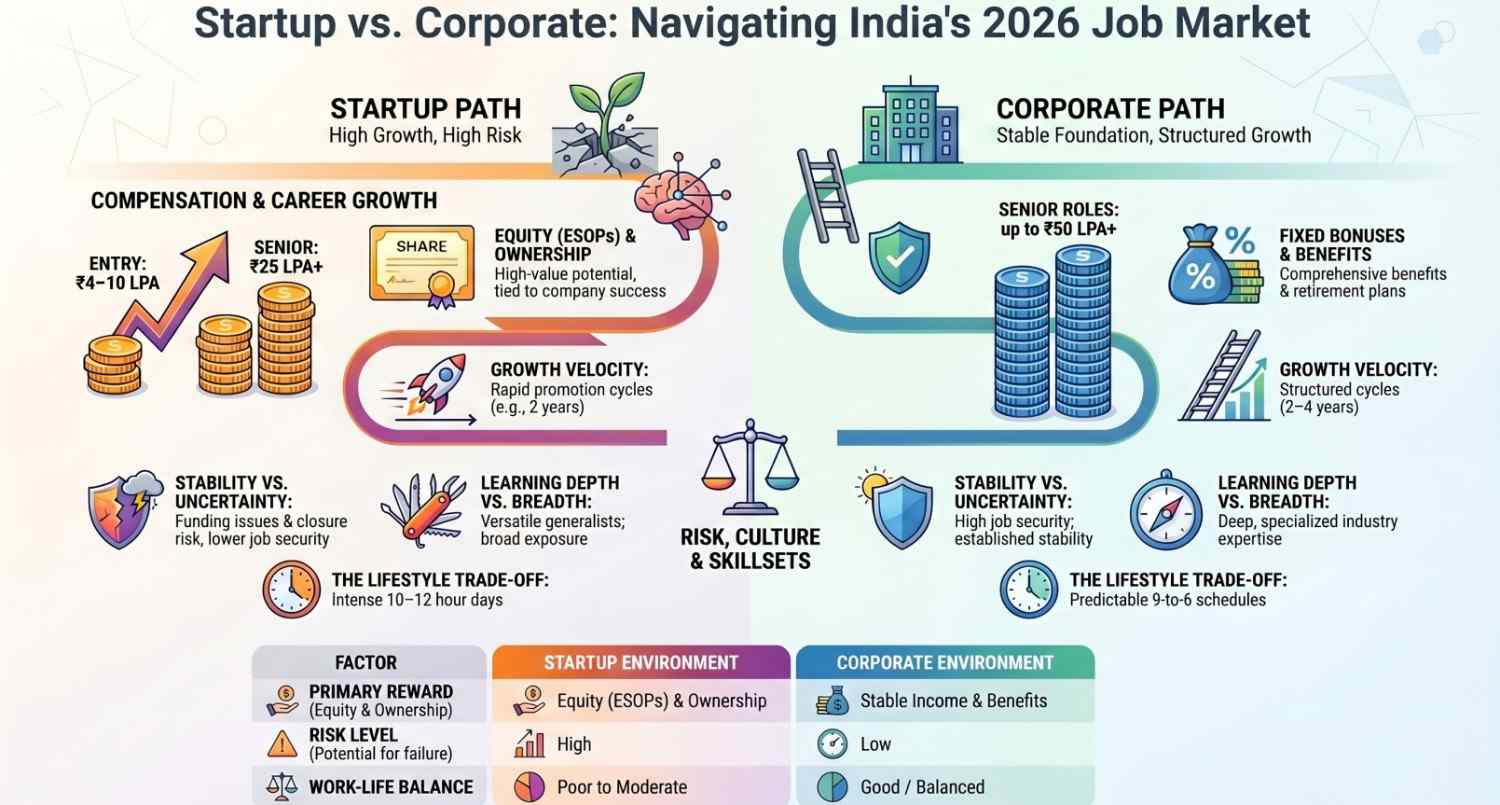
- Entry-level: ₹4–10 LPA
- Mid-level: ₹10–25 LPA
- Senior roles: ₹25 LPA+ (plus ESOPs)
Startups may offer:
- Slightly lower fixed salary
- Equity (ESOPs)
- Performance bonuses
Example: A startup might offer ₹12 LPA + ESOPs worth ₹8 LPA (potential future value).
Corporate Salaries
- Entry-level: ₹3–8 LPA
- Mid-level: ₹8–20 LPA
- Senior roles: ₹20–50 LPA+
Corporates offer:
- Fixed salary
- Annual bonuses
- Benefits (PF, insurance, perks)
Example: ₹15 LPA fixed + bonus + job security
Verdict on Salary
- Short-term: Corporate jobs win (stable income)
- Long-term: Startups can win big (if equity pays off)
Career Growth & Learning
Growth in Startups
Startups are like career accelerators.
You might:
- Handle multiple roles
- Get promoted quickly
- Work directly with founders
Example: You join as a marketing executive and become a manager within 2 years.
Growth in Corporates
Growth is structured but slower.
You’ll see:
- Defined promotion cycles
- Specialized roles
- Formal training programs
Example: Promotion every 2–4 years based on performance.
Verdict on Growth
- Fast growth: Startups
- Stable & predictable growth: Corporates
Risk & Job Security
Startup Risks
Startups come with uncertainty.
Risks include:
- Company shutdown
- Funding issues
- Sudden layoffs
Reality: Many startups fail within the first 5 years.
Corporate Stability
Corporate jobs are relatively safer.
Benefits:
- Stable income
- Lower layoff risk (but not zero)
- Strong HR policies
Verdict on Risk
- High risk: Startups
- Low risk: Corporates
Work Culture & Lifestyle
Startup Culture
- Fast-paced
- Long hours
- Informal environment
You may work:
- 10–12 hours/day
- Weekends occasionally
But you’ll also get:
- Flexibility
- Ownership
- Creative freedom
Corporate Culture
- Structured
- Predictable work hours
- Formal environment
Typical schedule:
- 9 to 6 job
- Weekends off
Verdict on Lifestyle
- Flexible but intense: Startups
- Balanced and stable: Corporates
Skill Development
In Startups
You learn everything:
- Marketing
- Sales
- Operations
- Problem-solving
Ideal for:
- Generalists
- Entrepreneurs
In Corporates
You learn deep specialization:
- One domain expertise
- Industry-specific skills
Ideal for:
- Specialists
- Long-term professionals
Who Should Choose Startups?
Startups are best if you:
- Are comfortable with risk
- Want rapid career growth
- Enjoy learning multiple skills
- Dream of building your own company someday
Who Should Choose Corporate Jobs?
Corporate roles are ideal if you:
- Prefer stability
- Want predictable income
- Value work-life balance
- Have financial responsibilities
Startup vs Corporate: Quick Comparison
| Factor | Startup | Corporate |
|---|---|---|
| Salary | Variable + ESOPs | Stable + benefits |
| Growth | Fast | Slow & structured |
| Risk | High | Low |
| Work-Life Balance | Poor to moderate | Good |
| Learning | Broad | Specialized |
What’s Changing in 2026?
India’s job ecosystem is evolving:
- Startups are offering better salaries than before
- Corporates are becoming more flexible (remote work, innovation labs)
- Hybrid careers are rising (startup → corporate → startup)
The line between startup and corporate is slowly blurring.
Final Thoughts
There’s no “one-size-fits-all” answer.
- If you want security and stability, go corporate
- If you want growth and excitement, go startup
A smart strategy many professionals follow:
Start in a startup → learn fast → move to corporate (or vice versa)
Your career is a long journey what matters is choosing what aligns with your current stage of life.
So, What Should You Do?
Ask yourself:
- Can I handle financial risk?
- Do I want fast growth or stability?
- What matters more right now: money, learning, or balance?
Your answers will guide you better than any trend.