Machine Learning (ML) is a core part of modern technology used in apps, banking
systems, healthcare, and many more industries. Two of the most important
approaches in ML are Supervised Learning and Unsupervised Learning.
Understanding these will help you clearly know how machines learn from data and
make decisions.
What is Supervised Learning?
Supervised Learning is a type of Machine Learning where the model is trained using
labeled data, meaning every input comes with a correct output. The system learns
by comparing its predictions with actual answers and improving over time. It follows
a clear guidance process, just like a student learning from a teacher. The main aim is
to predict accurate results for new, unseen data. This method is widely used
because it is easy to train and gives reliable outputs when good data is available.
How Supervised Learning Work
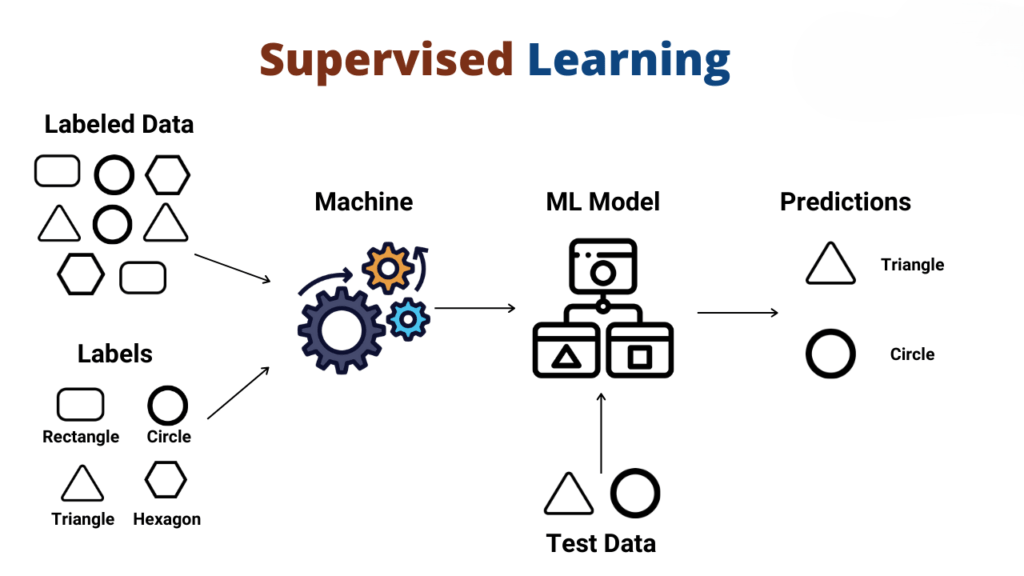
In supervised learning, the dataset is divided into input (X) and output (Y). The model
studies the relationship between them during training. After learning, it applies this
knowledge to predict outputs for new inputs. Algorithms continuously adjust
themselves to reduce errors and improve accuracy. This process is called training
and testing. Over time, the model becomes better at making predictions.
Real-Life Examples of Supervised Learning
Spam detection is a common example where emails are classified as spam or not
spam based on past labeled data. Another example is predicting student marks
using study hours and past performance. In healthcare, supervised learning helps
doctors predict diseases using patient data. It is also used in fraud detection in
banking systems. Face recognition systems also work using supervised learning
techniques.
Types of Supervised Learning
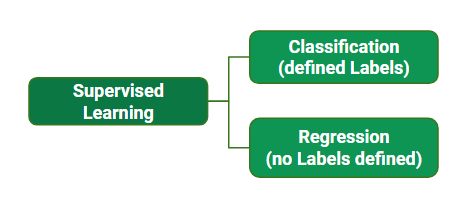
Supervised learning is mainly divided into two types: classification and regression.
Classification deals with predicting categories, such as yes or no, spam or not spam.
Regression deals with predicting numerical values like price, temperature, or marks.
Both types are widely used in real-world applications. Choosing the right type
depends on the problem you are solving.
What is Unsupervised Learning?
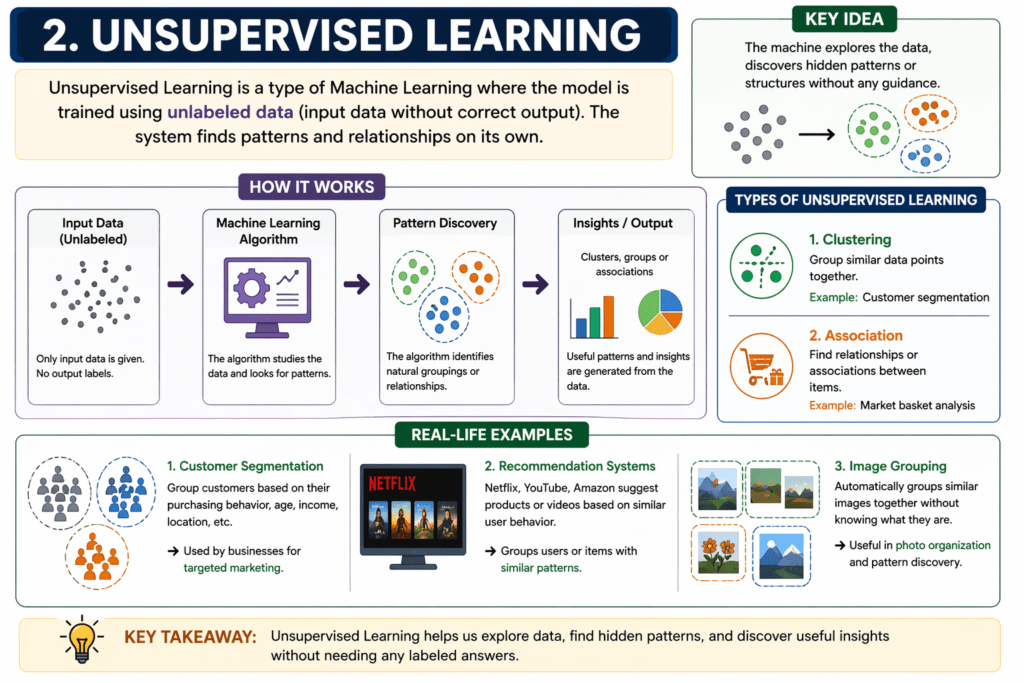
Unsupervised Learning is a type of Machine Learning where the model is trained
using unlabeled data. There are no predefined answers, and the system tries to find
patterns and relationships on its own. It works more like exploration rather than
guided learning. This method is useful when we do not know the expected output. It
helps in discovering hidden structures in data. Unsupervised learning is powerful but
slightly more complex than supervised learning.
How Unsupervised Learning Works
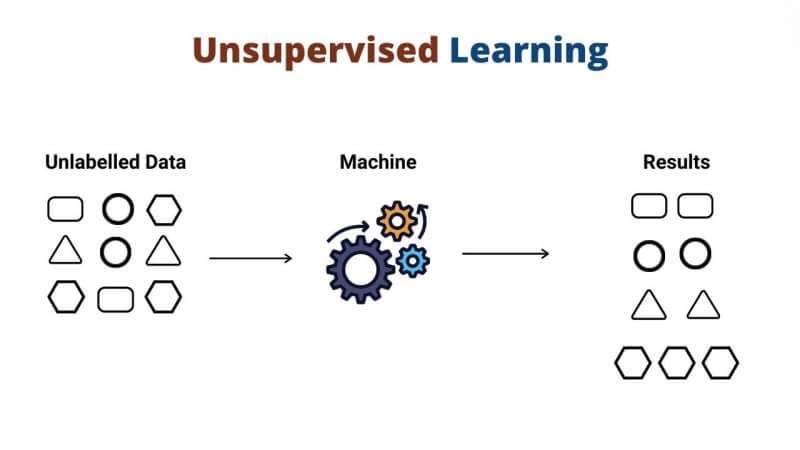
In unsupervised learning, only input data is provided without any labels. The
algorithm analyzes the data and identifies similarities or differences between data
points. It groups similar data together or finds relationships among them. The output
is usually clusters or patterns rather than exact answers. This makes it useful for
understanding large datasets. It is often used in data analysis and pattern
recognition.
Real-Life Examples of Unsupervised Learning
Customer segmentation is a popular example where businesses group customers
based on behavior. Recommendation systems like YouTube or Netflix suggest
content based on user activity patterns. It is also used in grouping similar images
without knowing their labels. Market basket analysis finds products that are often
bought together. Social network analysis also uses unsupervised learning to find
communities.
Types of Unsupervised Learning
The two main types are clustering and association. Clustering groups similar data
points together, such as grouping customers. Association finds relationships between
items, like products frequently bought together. These techniques are widely used in
business analytics. They help companies make better decisions based on data
insights.
Key Differences Between Supervised and
Unsupervised Learning
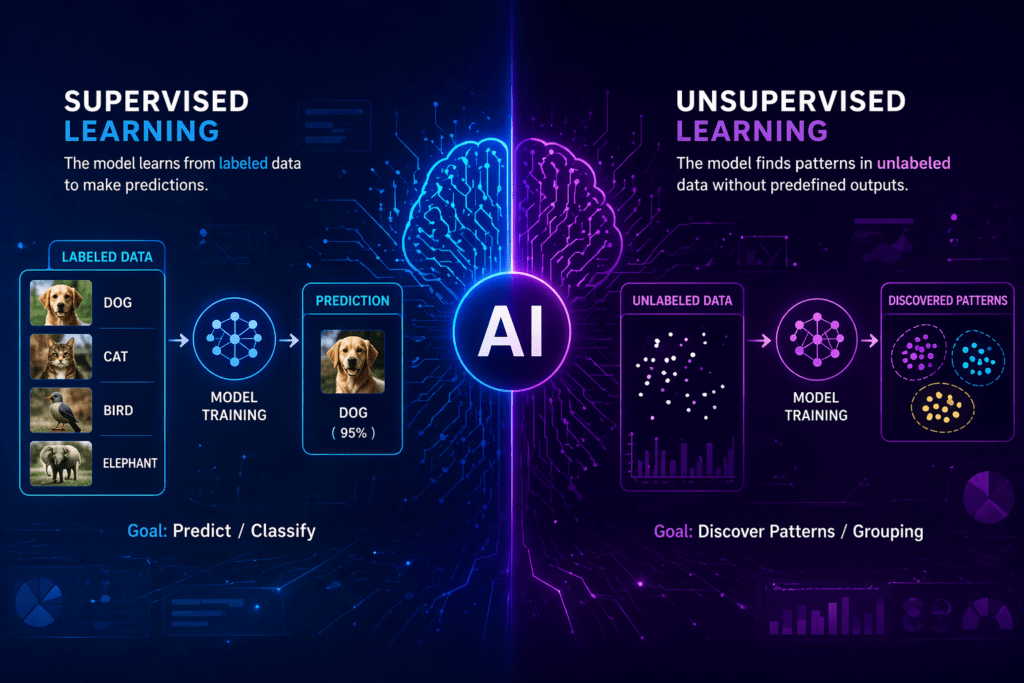
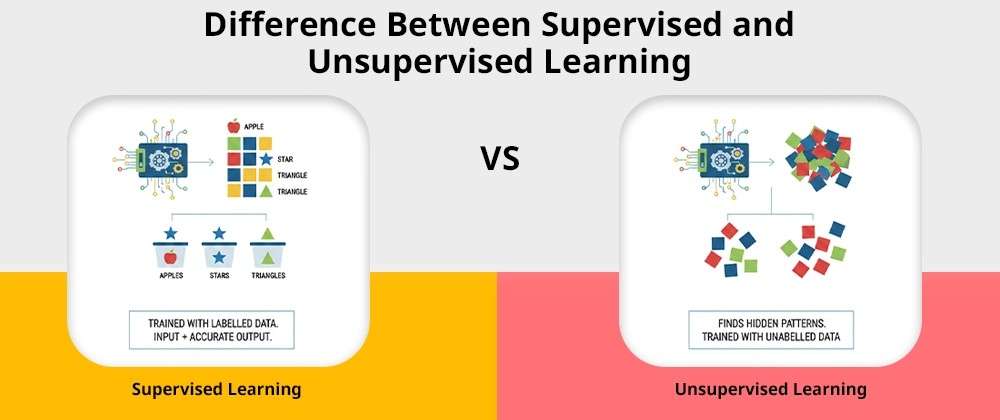
Supervised learning uses labeled data, while unsupervised learning uses unlabeled
data. Supervised learning focuses on predicting outcomes, whereas unsupervised
learning focuses on discovering patterns. Supervised learning requires guidance, but
unsupervised learning does not. The output in supervised learning is known, but in
unsupervised learning, it is unknown. Supervised learning is easier to implement,
while unsupervised learning is more complex and exploratory.
Real-World Analogy
Supervised learning is like a classroom where a teacher provides questions and
answers, helping students learn quickly and correctly. On the other hand,
unsupervised learning is like a scientist exploring unknown data without guidance.
The scientist observes patterns and makes discoveries independently. Both methods
represent different ways of learning. Each has its own importance depending on the
situation.
Advantages and Disadvantages
Supervised learning provides accurate results when labeled data is available, but
collecting labeled data can be expensive and time-consuming. Unsupervised
learning does not require labeled data, making it flexible, but the results may be less
predictable. Supervised models are easier to evaluate, while unsupervised models
require deeper analysis. Both methods have their strengths and limitations.
Choosing the right method depends on the problem.
Conclusion
Supervised and Unsupervised Learning are fundamental concepts in Machine
Learning. One focuses on prediction with guidance while the other focuses on
discovering hidden patterns. Both are widely used in real-world applications across
industries. Understanding these methods helps in building intelligent systems.
Together, they form the foundation of modern Artificial Intelligence.