
DevOps has evolved far beyond simple automation. In 2026, building an efficient pipeline means combining speed, scalability, security, and intelligence. The right tools can dramatically improve how teams build, test, deploy, and monitor applications.
This guide explores the top tools for building DevOps pipelines in 2026, covering CI/CD, containerization, infrastructure, monitoring, and emerging trends. Whether you’re a startup or an enterprise team, choosing the right stack can define your delivery success.
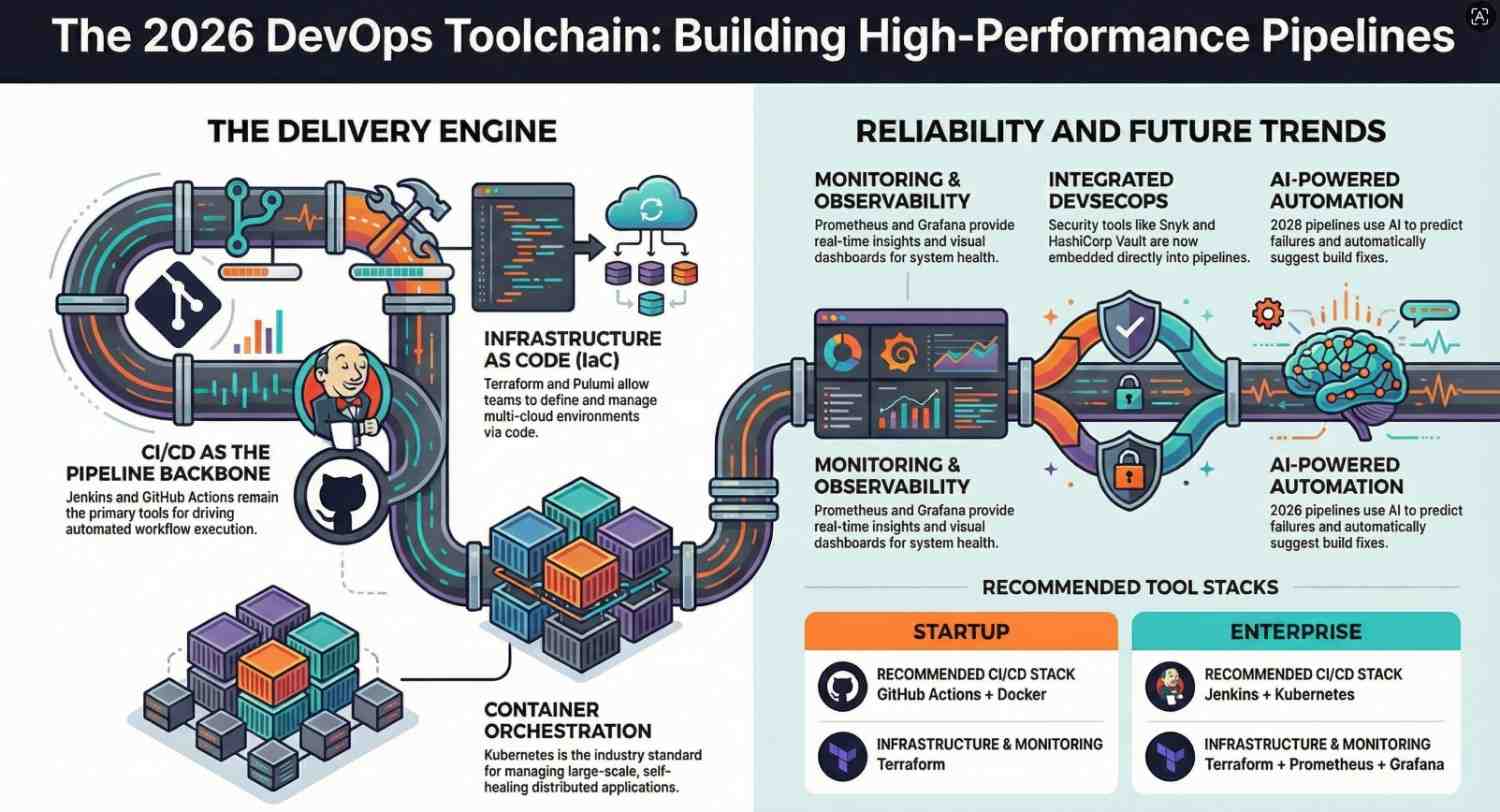
Why DevOps Pipeline Tools Matter
A DevOps pipeline is a series of automated steps that allow developers to move code from development to production quickly and reliably.
Key benefits of using the right tools:
- Faster release cycles
- Improved collaboration
- Reduced human error
- Better scalability
- Continuous feedback and monitoring
In 2026, pipelines are expected to be fully automated, cloud-native, and AI-assisted.
1. CI/CD Tools (The Backbone of DevOps)
Continuous Integration and Continuous Deployment tools are at the heart of every pipeline.
🔹 Jenkins
One of the most widely used open-source CI/CD tools.
Why it stands out:
- Highly customizable with plugins
- Strong community support
- Works with almost any tech stack
Best for: Teams needing flexibility and control
🔹 GitHub Actions
A modern CI/CD tool integrated directly into GitHub repositories.
Features:
- Native GitHub integration
- Easy workflow automation
- Large marketplace of prebuilt actions
Best for: Teams already using GitHub
🔹 GitLab CI/CD
An all-in-one DevOps platform with built-in CI/CD capabilities.
Highlights:
- Seamless integration with GitLab repos
- Built-in security and monitoring
- Easy pipeline configuration
Best for: End-to-end DevOps in one platform
🔹 CircleCI
Known for speed and cloud-native performance.
Strengths:
- Fast execution times
- Docker-native support
- Scalable infrastructure
Best for: Performance-focused teams
2. Containerization & Orchestration Tools
Modern pipelines rely heavily on containers for consistency and portability.
🔹 Docker
The foundation of container-based pipelines.
Why it matters:
- Consistent environments
- Lightweight deployments
- Easy integration with CI/CD tools
🔹 Kubernetes
The industry standard for managing containerized applications.
Key features:
- Auto-scaling
- Self-healing systems
- Load balancing
Best for: Large-scale distributed applications
🔹 Helm
Simplifies Kubernetes deployments using charts.
Use case:
- Managing complex Kubernetes apps
- Version-controlled deployments
3. Infrastructure as Code (IaC) Tools
IaC tools allow you to define and manage infrastructure through code.
🔹 Terraform
A leading IaC tool for multi-cloud environments.
Benefits:
- Cloud-agnostic
- Declarative configuration
- Strong ecosystem
🔹 AWS CloudFormation
Amazon’s native IaC solution.
Best for:
- AWS-focused environments
- Deep integration with AWS services
🔹 Pulumi
Lets you write infrastructure using programming languages.
Why it’s trending:
- Supports Python, JavaScript, Go
- Developer-friendly approach
4. Configuration Management Tools
These tools ensure systems are configured consistently.
🔹 Ansible
Agentless automation for configuration and deployment.
Advantages:
- Simple YAML syntax
- Easy to learn
- No agents required
🔹 Chef
🔹 Puppet
Use cases:
- Managing large infrastructure
- Enforcing system state
5. Monitoring & Observability Tools
Pipelines don’t end at deployment monitoring is critical.
🔹 Prometheus
A powerful open-source monitoring and alerting toolkit.
Features:
- Time-series database
- Alerting system
- Integration with Kubernetes
🔹 Grafana
Used for visualizing metrics and logs.
Why teams love it:
- Beautiful dashboards
- Real-time insights
- Works with multiple data sources
🔹 Datadog
A full-stack monitoring solution.
Best for:
- Cloud-native environments
- End-to-end observability
6. Artifact Management Tools
Artifacts are outputs of your pipeline (binaries, images, etc.).
🔹 JFrog Artifactory
Manages binaries and dependencies efficiently.
🔹 Nexus Repository
A popular alternative for artifact storage.
7. Security (DevSecOps) Tools
Security is now integrated into pipelines.
🔹 Snyk
Finds vulnerabilities in dependencies and containers.
🔹 Aqua Security
Focuses on securing containerized environments.
🔹 HashiCorp Vault
Securely manages secrets and credentials.
8. Emerging Tools & Trends in 2026
The DevOps landscape continues to evolve rapidly.
AI-Powered Pipelines
Tools now integrate AI to:
- Predict failures
- Optimize build times
- Suggest fixes automatically
Platform Engineering Tools
Internal developer platforms (IDPs) are gaining traction.
Example:
- Backstage (by Spotify)
Serverless CI/CD
Serverless tools eliminate infrastructure management.
Benefits:
- Lower costs
- Auto-scaling
- Faster setup
How to Choose the Right Tools
Selecting tools depends on your specific needs.
Consider:
- Team size and expertise
- Cloud provider
- Project complexity
- Budget
- Integration requirements
Example stacks:
Startup stack:
- GitHub Actions + Docker + Terraform
Enterprise stack:
- Jenkins + Kubernetes + Terraform + Prometheus + Grafana
Best Practices for Tool Selection
- Avoid tool overload keep your stack simple
- Choose tools with strong community support
- Prioritize integration compatibility
- Focus on scalability and future growth
- Regularly evaluate and update your stack
Common Mistakes to Avoid
- Overcomplicating pipelines with too many tools
- Ignoring security integration
- Not monitoring pipeline performance
- Choosing tools without long-term support
- Lack of documentation and training
Final Thoughts
In 2026, DevOps pipelines are more intelligent, automated, and scalable than ever. The tools you choose play a crucial role in determining how fast and reliably you can deliver software.
There’s no one-size-fits-all solution the best pipeline is the one tailored to your team’s needs. Start with a solid foundation, experiment with tools, and evolve your stack as your requirements grow.
By leveraging the right combination of CI/CD, containerization, infrastructure, monitoring, and security tools, you can build a high-performance DevOps pipeline that supports continuous innovation and rapid delivery.