
For years, SEO was a relatively stable discipline. You researched keywords, optimized pages, built backlinks, and watched your rankings climb at least in theory. But in 2026, the rules have shifted dramatically. Artificial intelligence is no longer just a tool supporting search engines; it is the engine.
This raises a critical question for marketers, creators, and businesses: who really controls rankings now AI or SEO?
The answer isn’t as simple as choosing one over the other. Instead, we’re witnessing a fundamental transformation where traditional SEO principles are being reinterpreted, filtered, and sometimes overridden by AI-driven systems.
Let’s break down what’s happening, what’s changed, and what still matters.
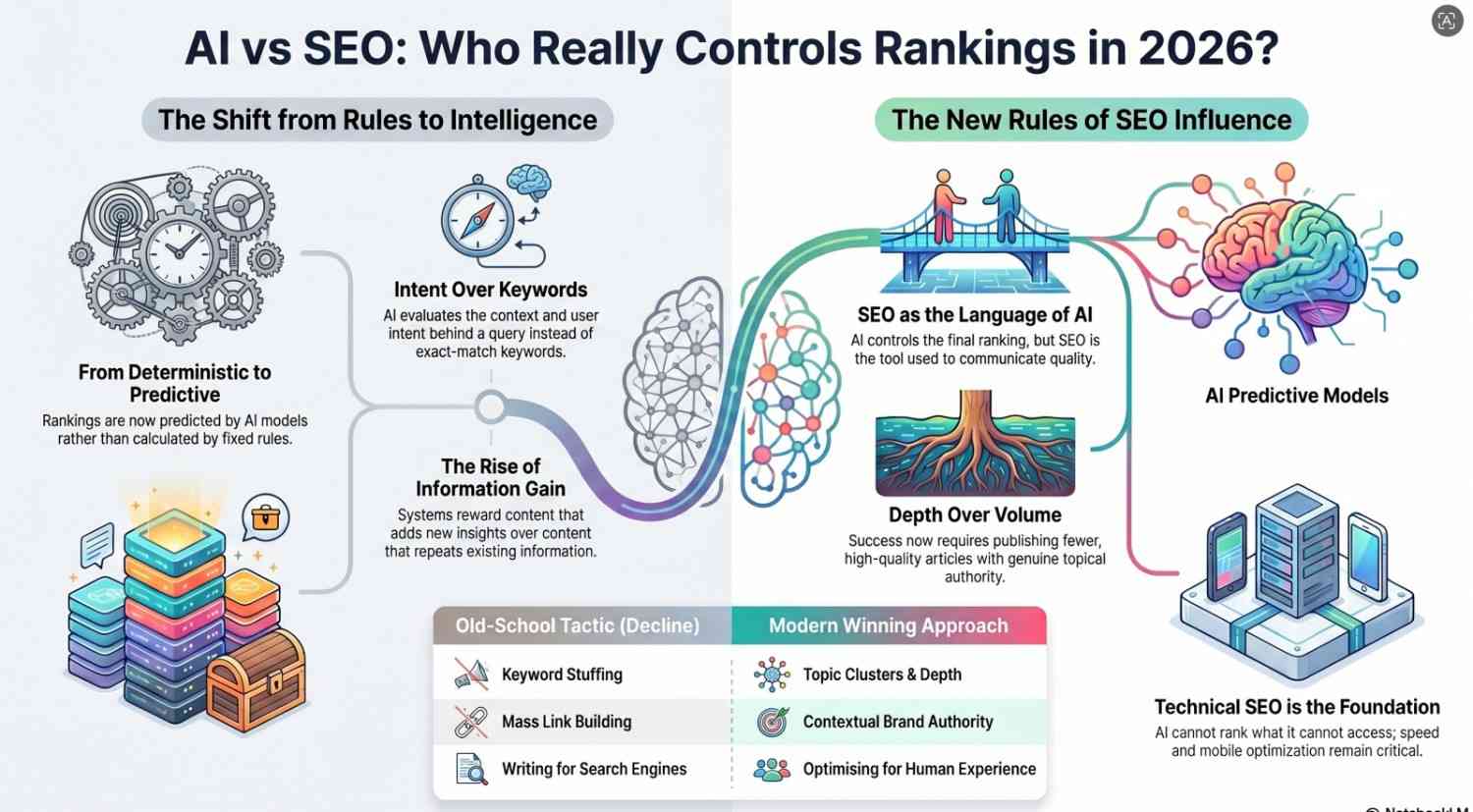
The Evolution of Search: From Rules to Intelligence
Search engines used to rely heavily on deterministic signals clear ranking factors like keyword density, backlinks, and technical optimization. While these factors still exist, they are no longer the primary decision-makers.
AI systems now evaluate:
- Context instead of just keywords
- User intent instead of exact matches
- Content usefulness instead of sheer volume
- Behavioral signals instead of static metrics
In other words, search has evolved from a rules-based system to a learning system.
This shift means rankings are no longer “controlled” in the traditional sense. They are predicted by AI models trained on massive datasets of user behavior and content performance.
What AI Actually Does in Rankings
To understand control, you need to understand AI’s role. AI isn’t just ranking pages it’s reshaping the entire search experience.
1. Interpreting Search Intent
AI models analyze queries in a human-like way. Instead of matching keywords, they try to understand:
- What the user really wants
- Whether they want information, a product, or a quick answer
- The context behind ambiguous queries
This means two users searching the same phrase might see completely different results.
2. Evaluating Content Quality
AI doesn’t just scan for keywords anymore. It evaluates:
- Depth of information
- Clarity and readability
- Originality
- Trustworthiness
Thin or generic content struggles to rank, even if it’s perfectly optimized in the traditional sense.
3. Personalizing Results
Search results are increasingly personalized based on:
- Location
- Search history
- Device usage
- Preferences and behavior
This makes rankings more fluid. There is no longer a single “#1 position” in the way there used to be.
4. Generating Answers Directly
One of the biggest disruptions is AI-generated answers appearing directly in search results. Users often get what they need without clicking any link.
This creates a new challenge:
You’re not just competing to rank you’re competing to be used by AI.
Where Traditional SEO Still Holds Power
Despite all these changes, SEO is far from dead. In fact, it’s more important than ever but its role has evolved.
1. Content Structure Still Matters
AI relies on structured, well-organized content to understand meaning.
Clear headings, logical flow, and semantic structure help AI interpret your page accurately.
Good SEO practices like:
- Proper HTML hierarchy
- Internal linking
- Schema markup
…still play a critical role in visibility.
2. Authority Signals Are Still Crucial
Backlinks haven’t disappeared they’ve matured.
Instead of counting links, AI evaluates:
- Relevance of the linking site
- Context of the link
- Overall authority of your domain
A few strong, relevant links can now outweigh dozens of low-quality ones.
3. Technical SEO Is the Foundation
AI can’t rank what it can’t access.
Technical SEO ensures:
- Fast page loading
- Mobile optimization
- Proper indexing
- Clean site architecture
Without these basics, even the best content won’t perform.
4. User Experience Drives Rankings
AI heavily relies on behavioral signals like:
- Click-through rate
- Time on page
- Bounce rate
- Engagement
If users don’t find your content useful, rankings will drop no matter how optimized your page is.
The Real Shift: From Optimization to Alignment
The biggest misconception today is thinking SEO is about “beating the algorithm.”
That mindset is outdated.
Modern SEO is about aligning with AI systems, not manipulating them.
This means:
- Creating genuinely helpful content
- Solving real user problems
- Providing clear and trustworthy information
Instead of asking, “How do I rank for this keyword?”
You should ask, “How do I become the best answer for this topic?”
AI as a Tool: Friend or Competitor?
AI plays a dual role it’s both a competitor and a tool.
AI as a Competitor
- It answers questions directly
- It reduces clicks to websites
- It aggregates content from multiple sources
This can significantly reduce organic traffic for certain queries.
AI as a Tool
On the flip side, AI helps creators:
- Generate content ideas
- Optimize structure and readability
- Analyze search trends
- Automate repetitive SEO tasks
Those who leverage AI effectively gain a significant advantage.
New Ranking Factors Emerging in 2026
While traditional factors still matter, new signals are gaining importance:
1. Topical Authority
Instead of ranking single pages, AI evaluates your expertise across an entire topic.
Websites that consistently cover a subject in depth are rewarded.
2. Information Gain
Content that adds new insights or perspectives ranks better than content that simply repeats existing information.
Originality is now measurable.
3. Brand Signals
Search engines increasingly favor recognizable and trustworthy brands.
This includes:
- Brand mentions
- Direct searches
- Online reputation
4. Content Freshness with Context
Fresh content matters but only when the topic requires it.
AI understands when updates are necessary and when evergreen content is sufficient.
The Decline of Old-School SEO Tactics
Some strategies that once worked are now ineffective or even harmful:
- Keyword stuffing
- Mass link building
- Thin affiliate pages
- Duplicate or spun content
- Writing purely for search engines instead of users
AI systems can easily detect these patterns and penalize them.
What Winning SEO Looks Like Now
To succeed in 2026, your approach needs to evolve.
Focus on Depth Over Volume
Publishing fewer, high-quality articles is more effective than mass-producing content.
Build Topic Clusters
Instead of isolated posts, create interconnected content around a central theme.
Optimize for Humans First
If your content satisfies real users, AI will recognize and reward it.
Think Beyond Search Engines
Traffic now comes from multiple sources:
- AI assistants
- Voice search
- Social platforms
- Direct engagement
SEO is no longer just about search engines it’s about visibility everywhere.
So, Who Really Controls Rankings?
Here’s the honest answer:
AI controls rankings but SEO influences AI.
AI is the decision-maker, but SEO is the language you use to communicate with it.
You don’t control rankings directly anymore.
What you control is:
- The quality of your content
- The clarity of your message
- The experience you provide
- The authority you build
AI then interprets these signals and determines where you belong.
The Future: Collaboration, Not Competition
The relationship between AI and SEO isn’t adversarial it’s collaborative.
The best-performing creators and businesses are those who:
- Understand how AI evaluates content
- Adapt their strategies accordingly
- Focus on delivering real value
SEO is no longer about gaming the system.
It’s about working with intelligent systems to serve users better.
Final Thoughts
The SEO landscape in 2026 is more complex but also more fair.
Shortcuts are fading. Genuine value is rising.
AI hasn’t replaced SEO it has refined it.
If you’re still relying on outdated tactics, rankings will slip.
But if you embrace the shift, focus on quality, and align with how AI works, the opportunities are bigger than ever.
In the end, the question isn’t whether AI or SEO controls rankings.