
From messy datasets to accurate predictions, Artificial Intelligence is transforming how data science works. It automates complex tasks, improves accuracy, and helps uncover hidden patterns that would otherwise remain hidden.
Introduction
In today’s digital world, massive amounts of data are generated every second from various sources such as social media, online transactions, and sensors. However, raw data alone has little value unless it is processed and analyzed effectively.
Artificial Intelligence (AI) plays a crucial role in transforming this raw data into meaningful insights and accurate predictions. By automating repetitive tasks and reducing human effort, AI makes the data science process faster, smarter, and more efficient. Many companies today rely on AI-driven data science to make better business decisions and improve customer experiences..
Data Collection
The first step in any data science project is collecting data from different sources such as databases, websites, sensors, and APIs. This data can be structured or unstructured and often comes in large volumes.
AI helps by automatically identifying useful data sources and gathering relevant information. It can also filter out unnecessary or low-quality data, ensuring that only meaningful data is used for analysis. This saves time and improves the overall quality of the dataset.
Data Cleaning
Raw data is often incomplete, inconsistent, and may contain errors. It may include missing values, duplicate entries, or incorrect formats. Data cleaning is one of the most important steps because poor-quality data can lead to inaccurate results.
AI helps improve data quality by:
- Filling missing values intelligently
- Removing duplicate records
- Detecting outliers and unusual patterns
- Standardizing data formats
For example, in a customer database, missing or incorrect information can affect business decisions. AI ensures that the data is clean, reliable, and ready for further analysis. stages

Exploratory Data Analysis (EDA)
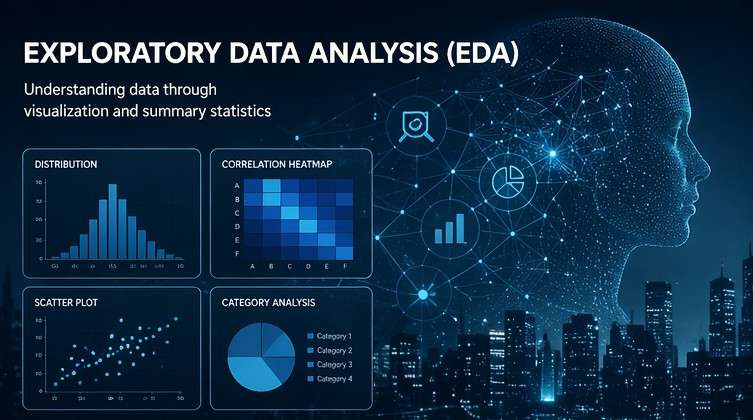
After cleaning the data, the next step is to understand it using Exploratory Data Analysis (EDA). This involves analyzing patterns, trends, and relationships within the data.
AI-powered tools can quickly process large datasets and generate useful insights. They help identify correlations between variables and suggest appropriate visualizations such as graphs and charts. Without EDA, important patterns may remain hidden, leading to poor model performance.
Feature Engineering
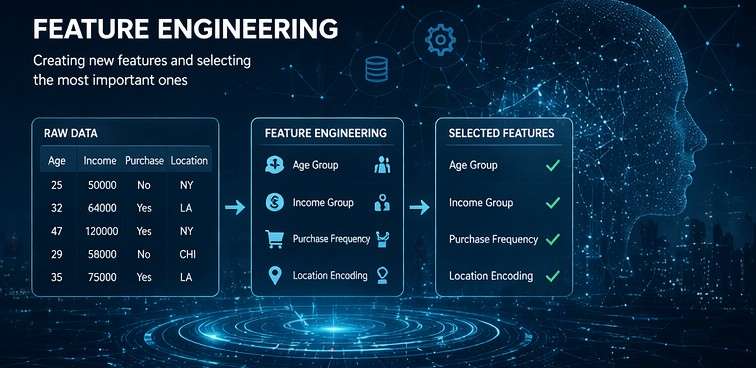
Feature engineering is the process of selecting and creating the most important variables (features) for a machine learning model. Not all data is useful, and choosing the right features can significantly improve model accuracy.
AI helps by selecting relevant features, creating new meaningful ones, and removing unnecessary data. In many cases, better features lead to better predictions, even more than increasing the amount of data.
Model Building
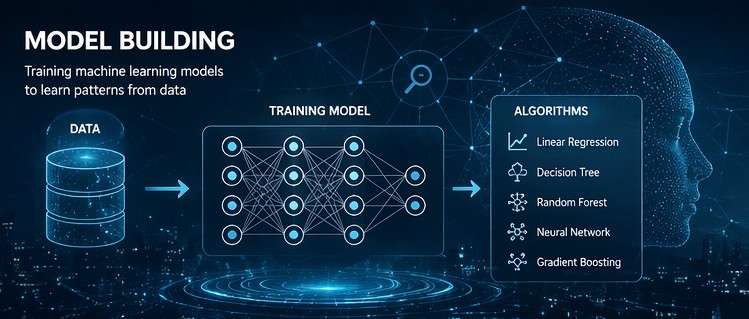
In this stage, machine learning models are developed using algorithms such as linear regression, decision trees, and neural networks. These models learn patterns from the data and establish relationships between inputs and outputs.
AI makes this process more efficient by automating model selection and tuning parameters. This allows data scientists to focus on solving real-world problems rather than spending too much time on manual adjustments.
Prediction and Evaluation
Once the model is trained, it is used to make predictions such as forecasting sales, predicting customer behavior, or detecting fraud. These predictions help organizations make informed decisions.
AI also evaluates the model’s performance using metrics such as accuracy, precision, and error rates. This ensures that the model produces reliable results when applied to new data. Continuous evaluation helps improve the model over time.

Conclusion
Artificial Intelligence has become an essential part of the data science process. It improves efficiency, reduces manual effort, and enhances accuracy at every stage, from data collection to prediction.
As technology continues to evolve, AI will play an even greater role in shaping the future of data-driven decision-making. Understanding how AI works in data science is important for anyone who wants to build a career in this field.
In a world driven by data, those who understand how to use AI effectively will lead the future.