
Freelancing in cloud computing has exploded over the past few years. Businesses of all sizes are moving their infrastructure to the cloud, and many prefer hiring freelancers over full-time engineers for flexibility and cost efficiency. That’s created a massive opportunity for cloud professionals especially those skilled in platforms like AWS and Azure.
But here’s the real question freelancers keep asking: Which cloud platform actually pays more per project AWS or Azure?
The answer isn’t as straightforward as picking a winner. It depends on demand, client type, project complexity, and your skill stack. Let’s break it down in a practical, no-hype way so you can decide where to focus.
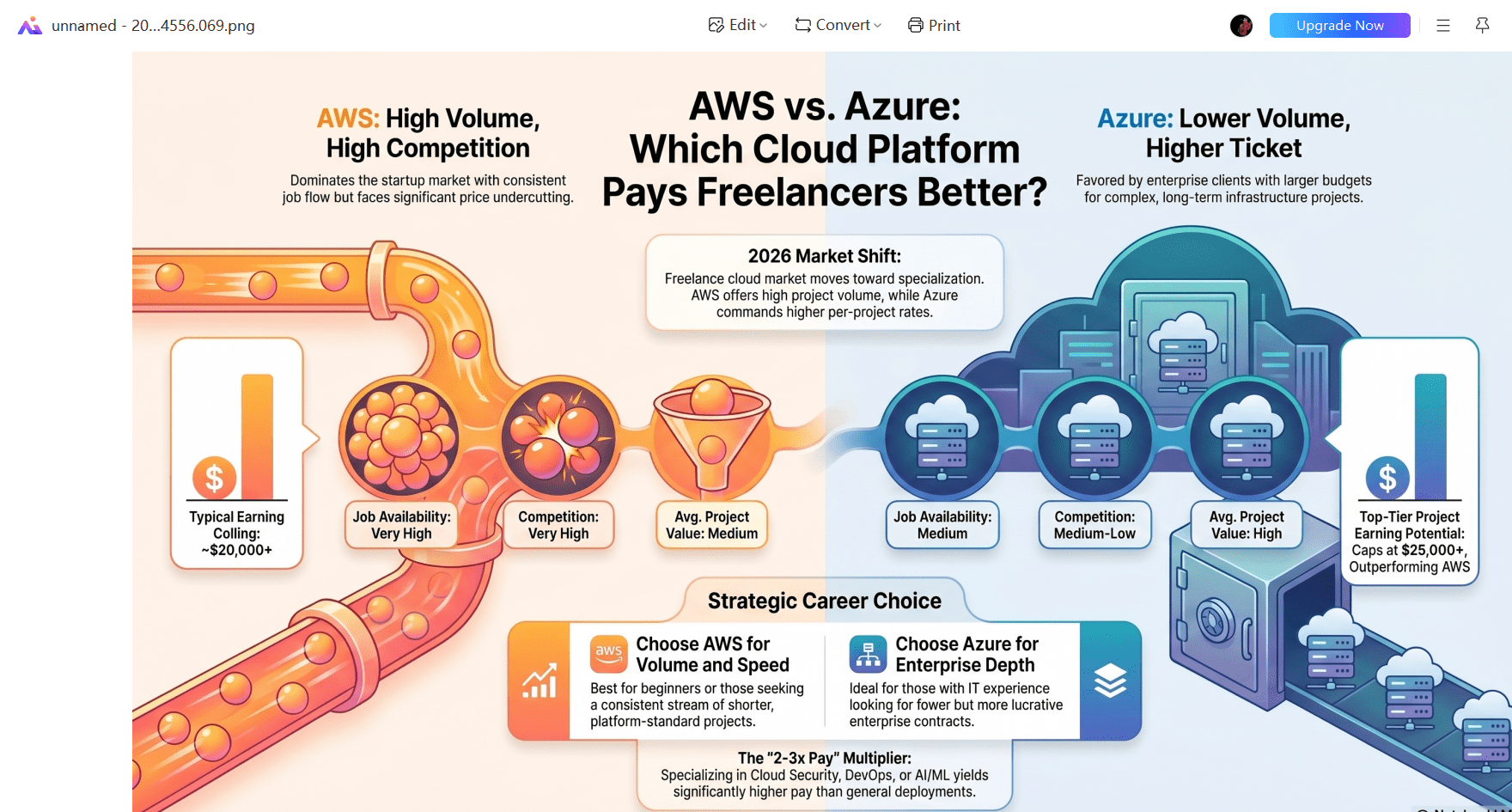
The Freelance Cloud Market in 2026
Cloud freelancing is no longer just about spinning up servers. Today’s projects include:
- Cloud migration (on-prem → cloud)
- DevOps pipeline setup
- Infrastructure as Code (IaC)
- Cloud security audits
- Cost optimization
- AI/ML deployment pipelines
Clients hiring freelancers range from startups to enterprises, and even government-backed organizations. The biggest change? Clients now want specialists, not generalists.
This is where AWS and Azure start to diverge.
AWS Freelance Jobs: High Volume, Competitive Pricing
AWS still dominates the global cloud market in terms of usage. That translates directly into more freelance job postings.
Typical AWS Freelance Projects
- EC2 + S3 architecture setups
- CI/CD pipelines using tools like Jenkins or GitHub Actions
- Kubernetes deployments (EKS)
- Serverless apps using Lambda
- Cloud cost optimization
Average Project Rates (2026)
- Small projects: $200 – $800
- Mid-level: $1,000 – $5,000
- Large projects: $5,000 – $20,000+
Why AWS Pays Well
- Massive demand worldwide
- Mature ecosystem (more tools, more use cases)
- Startups heavily prefer AWS
The Catch
AWS has a huge talent pool, especially in countries like India. That means:
- More competition
- Price undercutting is common
- Harder to stand out as a beginner
Bottom line: AWS gives you more opportunities, but not always the highest pay per project unless you specialize.
Azure Freelance Jobs: Lower Competition, Higher Ticket Projects
Azure is growing fast, especially in enterprise environments. Companies already using Microsoft products (Windows Server, Active Directory, Office 365) tend to prefer Azure.
Typical Azure Freelance Projects
- Azure Active Directory (AAD) integrations
- Hybrid cloud setups (on-prem + Azure)
- Enterprise migrations
- Power Platform automation
- Security & compliance implementations
Average Project Rates (2026)
- Small projects: $300 – $1,000
- Mid-level: $2,000 – $7,000
- Large projects: $7,000 – $25,000+
Why Azure Pays More Per Project
- Enterprise clients have bigger budgets
- Fewer skilled freelancers compared to AWS
- Projects are often complex and long-term
The Catch
- Fewer freelance gigs overall
- Requires deeper knowledge of enterprise systems
- Slower entry for beginners
Bottom line: Azure often pays more per project, but opportunities are fewer and expectations are higher.
AWS vs Azure: Direct Comparison
| Factor | AWS | Azure |
|---|---|---|
| Job Availability | Very High | Medium |
| Competition | Very High | Medium-Low |
| Average Project Value | Medium | High |
| Beginner Friendly | Yes | Moderate |
| Enterprise Projects | Moderate | Very High |
| Freelance Platforms Presence | Strong | Growing |
Where the Real Money Is (Hint: Not Just the Platform)
If you focus only on AWS vs Azure, you’re missing the bigger picture. Clients don’t pay for platforms they pay for solutions.
High-Paying Freelance Niches (Both AWS & Azure)
- Cloud Security (very high demand)
- DevOps + Automation
- Kubernetes / Containerization
- FinOps (cost optimization)
- AI/ML deployment
A freelancer with DevOps + Cloud + Security skills can charge 2–3x more than someone doing basic deployments.
Real Freelance Scenarios
Scenario 1: Startup Founder (AWS)
A startup needs a scalable backend.
- Budget: $2,000
- Stack: AWS Lambda + DynamoDB
- Timeline: 2 weeks
Outcome: Fast project, decent pay, but high competition.
Scenario 2: Enterprise Migration (Azure)
A company wants to move from on-prem servers to Azure.
- Budget: $15,000
- Stack: Azure VMs + Active Directory
- Timeline: 2–3 months
Outcome: Fewer bidders, higher complexity, much better pay.
Scenario 3: DevOps Automation (Both)
Client doesn’t care about AWS or Azure they want automation.
- Budget: $5,000
- Tools: Terraform + CI/CD
- Timeline: 1 month
Outcome: Platform becomes secondary skills matter more.
Freelance Platforms: Where You’ll Find These Jobs
Popular platforms include:
- Upwork
- Freelancer
- Toptal
- Fiverr Pro
AWS jobs dominate volume on these platforms, but Azure jobs often appear in premium or invite-only listings.
Which One Should You Choose?
Choose AWS if:
- You’re a beginner entering freelancing
- You want consistent project flow
- You’re okay with competitive pricing
- You plan to specialize later
Choose Azure if:
- You already have IT or enterprise experience
- You want higher-paying, long-term projects
- You understand Microsoft ecosystems
- You prefer fewer but bigger clients
The Smart Strategy (What Top Freelancers Do)
The highest-earning freelancers don’t limit themselves to one platform.
They:
- Start with AWS for quick projects
- Learn Azure for enterprise contracts
- Build a niche (DevOps, Security, AI)
- Position themselves as problem solvers, not cloud engineers
This hybrid approach gives:
- More opportunities (AWS)
- Higher ticket sizes (Azure)
Future Outlook: 2026 and Beyond
- AWS will continue to dominate startups and global projects
- Azure will keep growing in enterprise and government sectors
- Multi-cloud skills will become more valuable
- Freelancers who combine cloud + AI + automation will earn the most
The biggest shift? Clients are moving toward outcome-based hiring, not hourly work.
Final Verdict
So, which pays better per project?
- AWS: More projects, moderate pay
- Azure: Fewer projects, higher pay
If you’re looking purely at per-project earnings, Azure often wins.
If you’re looking at consistent income and volume, AWS is the safer bet.
But the real answer is this:
The highest-paid freelancers don’t choose between AWS and Azure they use both strategically.
Closing Thought
Freelancing in cloud isn’t just about learning a platform it’s about solving business problems.
If you can:
- Reduce cloud costs
- Improve system performance
- Automate workflows
Clients will pay you well whether it’s AWS, Azure, or anything else.