
In a world shaped by rapid technological evolution, one question keeps surfacing among students, career switchers, and even experienced professionals: Is software development still a good career in 2026? With the rise of automation, artificial intelligence, and no-code platforms, it’s a fair concern. But the short answer is yes software development remains one of the most promising and resilient career paths today. The long answer, however, is more nuanced and worth exploring in depth
The Changing Landscape of Software Development
Software development in 2026 doesn’t look exactly like it did five or ten years ago. Tools have become smarter, workflows more automated, and expectations higher. Platforms powered by Artificial Intelligence including tools like ChatGPT can now generate code, debug errors, and even suggest architecture improvements.
At first glance, this might seem like a threat. If machines can write code, what happens to developers?
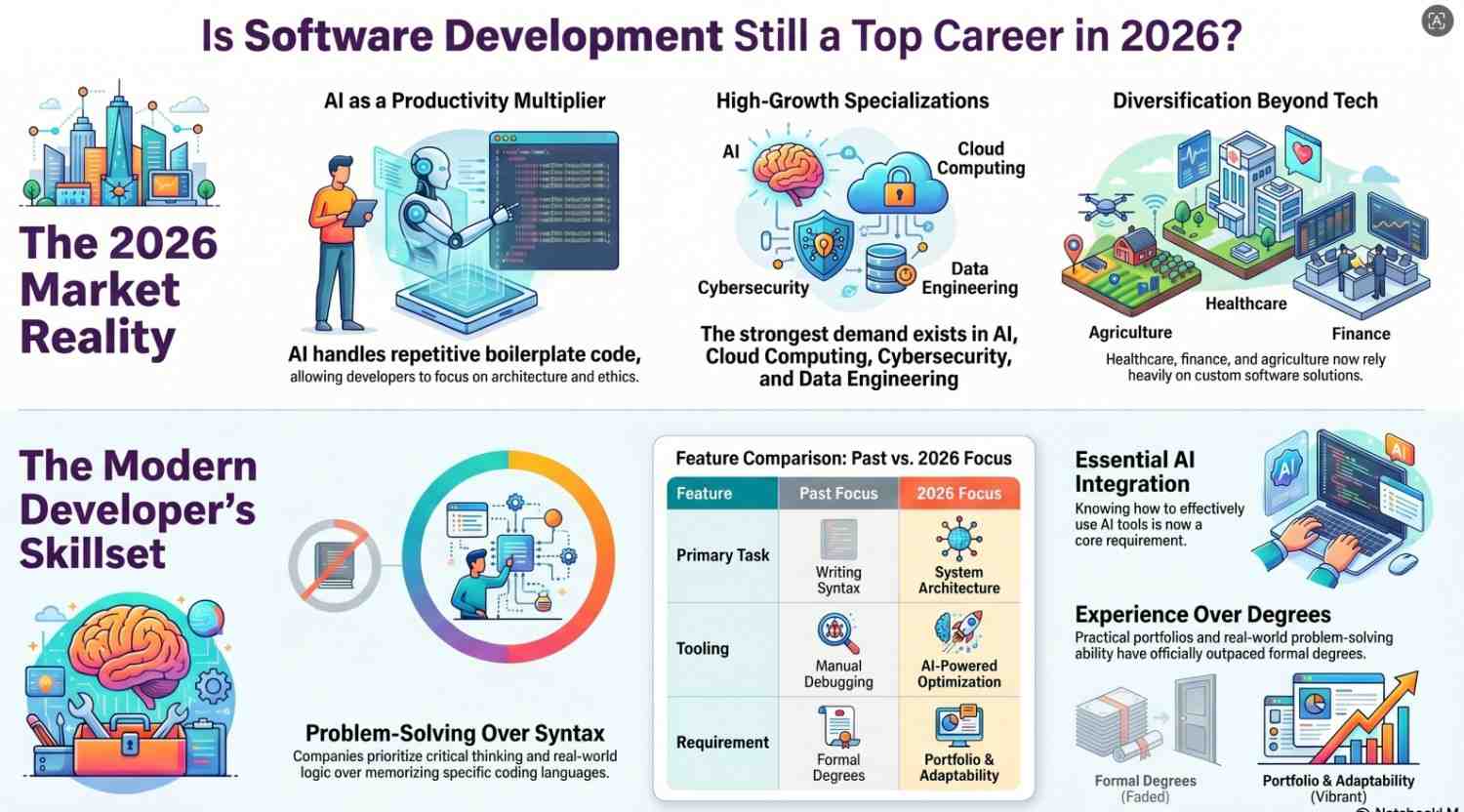
In reality, these tools are transforming not replacing the role of developers. Instead of spending hours writing repetitive code, developers are now focusing on higher-level problem solving, system design, and creative thinking. Coding hasn’t disappeared; it has evolved.
Demand for Developers in 2026
Despite all the changes, demand for software developers remains strong across industries. Businesses today are more digital than ever:
- E-commerce platforms continue to expand
- Mobile apps dominate user engagement
- Cloud-based systems are standard
- AI-driven solutions are becoming essential
From startups to large enterprises, companies need skilled developers to build, maintain, and scale their digital infrastructure.
More importantly, software development is no longer limited to tech companies. Healthcare, finance, education, agriculture, and even government sectors rely heavily on software solutions. This diversification has actually increased job opportunities rather than shrinking them.
The Role of AI: Threat or Opportunity?
The rise of AI is the biggest factor influencing the future of software development. Tools can now:
- Generate boilerplate code
- Suggest bug fixes
- Automate testing
- Assist in documentation
But here’s the key point: AI lacks context, judgment, and human understanding.
Developers are still needed to:
- Define problems clearly
- Design system architecture
- Make critical decisions
- Ensure ethical and secure implementation
Rather than replacing developers, AI is acting as a productivity multiplier. Developers who learn to use AI tools effectively are becoming more valuable not less.
Skills That Matter More Than Ever
In 2026, being a successful developer requires more than just knowing how to code. The skill set has expanded significantly.
1. Problem-Solving Ability
Companies are hiring people who can think critically and solve real-world problems, not just write syntax.
2. Understanding of Systems
Knowledge of how different technologies work together APIs, databases, cloud infrastructure is crucial.
3. Adaptability
Technology changes quickly. Developers must continuously learn new languages, frameworks, and tools.
4. Communication Skills
Working in teams, explaining ideas, and collaborating across departments are essential skills.
5. AI Integration
Knowing how to use AI tools effectively is becoming a core skill rather than a bonus.
Is Coding Still Worth Learning?
Absolutely but with a modern approach.
Learning to code in 2026 is not about memorizing syntax or mastering a single language. Instead, it’s about understanding logic, structure, and how to build solutions.
Languages like JavaScript, Python, and Go are still widely used, but what matters more is the ability to learn any language quickly when needed.
Coding is still the foundation, but it’s no longer the entire house.
Salary and Career Growth
Software development continues to offer strong financial rewards. Salaries vary by region, experience, and specialization, but overall trends remain positive.
High-demand areas include:
Freelancing and remote work have also expanded opportunities. Developers can now work with global clients, increasing earning potential and flexibility.
Remote Work and Flexibility
One of the biggest advantages of a career in software development is flexibility. Even in 2026, remote work remains a standard option for many roles.
Developers can:
- Work from home
- Choose freelance or full-time roles
- Collaborate with international teams
This flexibility makes the career attractive not just financially, but also in terms of lifestyle.
Challenges in 2026
While the field is promising, it’s not without challenges.
Increased Competition
More people are entering tech, making entry-level roles more competitive.
Higher Expectations
Companies expect developers to know more than just coding they want full-stack awareness, DevOps knowledge, and sometimes even product thinking.
Continuous Learning
The need to constantly update skills can be exhausting for some.
AI Dependency Risk
Relying too heavily on AI tools without understanding fundamentals can weaken core skills.
Web Development: Oversaturated or Evolving?
A common concern is whether web development is oversaturated. The answer: partially but not entirely.
Basic website creation has become easier due to no-code tools. However, complex web applications still require skilled developers.
The demand has shifted toward:
- Advanced frontend frameworks
- Performance optimization
- Scalable backend systems
- Security-focused development
So while entry-level web development may feel crowded, specialized developers remain in high demand.
Freelancing vs Full-Time Jobs
Both paths are viable in 2026, depending on your goals.
Freelancing
- Flexible schedule
- Potentially higher earnings
- Requires self-discipline and client management
Full-Time Jobs
- Stable income
- Team collaboration
- Career growth within organizations
Many developers combine both working a full-time job while taking freelance projects on the side.
Do You Still Need a Degree?
A formal degree is no longer a strict requirement for becoming a developer.
What matters more:
- Practical skills
- Portfolio projects
- Real-world experience
- Problem-solving ability
Many successful developers are self-taught or come from non-traditional backgrounds. Online learning platforms, coding bootcamps, and open-source contributions have made it easier than ever to enter the field.
The Future Outlook
Looking ahead, software development is not disappearing it’s expanding into new territories.
Emerging areas include:
- AI-driven applications
- Internet of Things (IoT)
- Blockchain technologies
- Augmented and virtual reality
As long as technology continues to evolve, developers will be needed to build and maintain it.
The role may change, tools may improve, but the core need for human creativity and problem-solving will remain.
Final Verdict
So, is software development still a good career in 2026?
Yes but only if you approach it the right way.
This is no longer a field where basic coding knowledge guarantees success. It rewards those who:
- Continuously learn
- Adapt to new technologies
- Think beyond code
- Embrace tools like AI rather than fear them
Software development is still one of the most future-proof careers available but it belongs to those who evolve with it.
Closing Thought
The real question isn’t whether software development is still a good career. It’s whether you’re willing to grow with it.
Because in 2026, the developers who succeed aren’t just coders they’re thinkers, builders, and problem solvers in a world that runs on technology.